







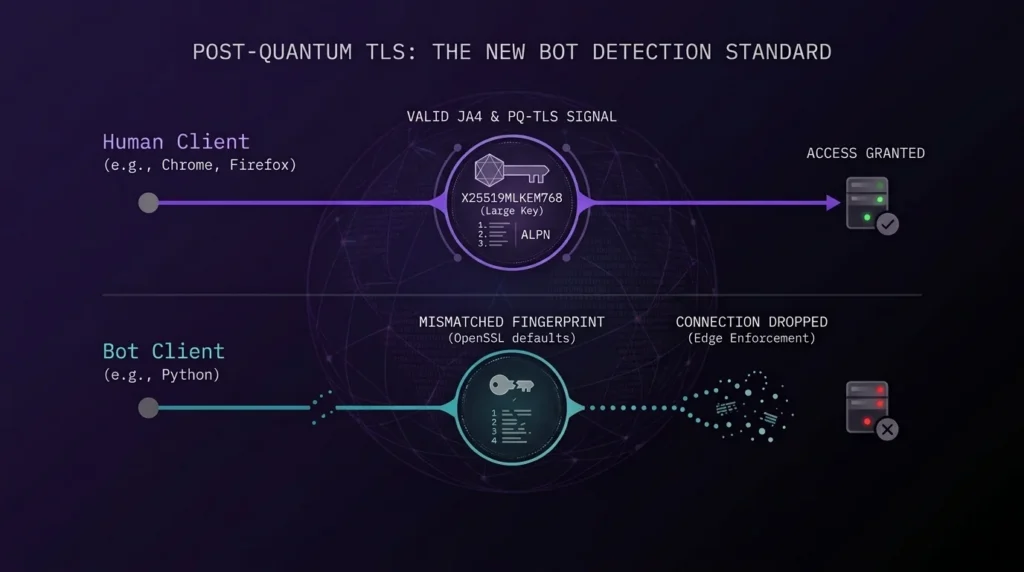
Content delivery networks now evaluate the cryptographic handshake rather than relying on cookies or rotating user agents.
Modern edge nodes inspect the exact sequence of bytes in the initial connection request long before the client transmits an HTTP payload. If the cryptographic math misaligns with standard Chrome or Firefox behavior, the server simply drops the connection.
This shift means stable data extraction completely depends on structuring valid network packets from the ground up.
TL;DR: Post-Quantum TLS and JA4 signals
- X25519MLKEM768 adds over 1,000 bytes to the TLS ClientHello packet.
- This massive size increase forces TCP MSS fragmentation during the handshake.
- CDN edge enforcement algorithms instantly block improper packet fragmentation.
- JA4 TLS fingerprinting replaced older standards to track ALPN and cipher suites dynamically.
- Standard automation libraries fail because they use default OpenSSL signatures.
TLS 1.3 Handshake mechanics and ClientHello detection
A script must negotiate a secure connection before loading a webpage. The TLS 1.3 handshake dictates how the client and server agree on encryption.
Commercial browsers transmit specific cryptographic preferences. Standard scripts default to generic system signatures.
Security filters analyze this discrepancy immediately. A request claims to be Chrome on Windows. The cipher suites indicate a Python script on a Linux server.
👉 Datacenter proxies to scale concurrent API requests and process public data.
This mismatch results in immediate connection resets. The edge node terminates the routing before generating a 403 status code.
How X25519MLKEM768 key shares trigger TCP fragmentation checks
Hybrid key exchange represents the current standard in network communication. Modern browsers combine standard elliptic curves with post-quantum cryptography. This specific algorithm operates as X25519MLKEM768.
It secures recorded traffic against future decryption attempts. It also alters the foundational mechanics of web scraping. Post-quantum TLS creates new detection signals directly tied to packet size. A traditional TLS ClientHello packet occupies roughly 300 bytes. The required post-quantum key share expands this payload to over 1,300 bytes.
This expansion pushes the payload beyond the standard Maximum Transmission Unit (MTU) limits. The network stack must split the packet.
Fixing TCP MSS fragmentation in ClientHello requests is a strict requirement for automation. Incorrect packet splitting flags the connection as anomalous at the firewall. Legitimate browsers fragment oversized packets according to exact operating system rules. Standard scripts delegate this to backend libraries with unpredictable results.
👉 Dedicated LTE/5G mobile proxies with unlimited traffic and clean IP addresses from real carriers.
Proper configuration of OS-level TCP fragmentation is the core of navigating X25519MLKEM768 enforcement.
Structuring JA4 TLS fingerprinting and ALPN sequencing
Security vendors utilize JA4 to categorize these complex handshakes. This standard outputs a readable hash based on the client’s network footprint. The algorithm logs the exact TLS version along with the specific order of cipher suites. The parser also records ALPN extensions.
Because real browsers inject random GREASE values to test server compatibility, the protocol tracks these bytes to verify authenticity. Cloudflare clienthello detection depends entirely on comprehensive JA4 databases. Edge networks map specific hashes to known automation frameworks. Default library settings produce a JA4 hash identical to a known script profile, causing the CDN edge to drop the connection instantly.
Modifying JA4 TLS fingerprints in Python requests remains technically impractical using standard modules. The default library relies entirely on the host system’s OpenSSL configuration. The architecture restricts direct modification of extension orders or GREASE value injections.
| Fingerprint Element | Real Browser Behavior | Default Python Script | Detection Risk |
| Cipher Suites | Ordered by modern AEAD preference | Ordered by OpenSSL defaults | High |
| ALPN | Requests h2, http/1.1 | Often missing or http/1.1 only | Critical |
| GREASE | Injects random values | Absent | High |
| Key Share | Includes X25519MLKEM768 | Basic X25519 only | Critical |
HTTP/2 framing fingerprint & SETTINGS validation
Network validation continues after the TLS handshake concludes. The protocol determines the application layer through ALPN. Modern architectures upgrade connections to HTTP/2.
This protocol operates on a binary framing layer. The client and server exchange SETTINGS frames immediately upon connection. These frames dictate limits for concurrent streams and initial window sizes.
Real browsers transmit highly specific frame configurations. Firefox dictates different limits than Chrome. Safari utilizes its own unique HTTP/2 framing fingerprint.
👉 Static residential ISP proxies for persistent sessions and stable profile management.
Standard automation tools transmit generic HTTP/2 settings or skip the exchange. Edge nodes monitor this initialization. A request with a Chrome TLS fingerprint and a generic Go library HTTP/2 structure triggers an immediate filter. Resolving uTLS inconsistencies requires perfect alignment across both the TLS and HTTP/2 layers.
Curl_cffi web scraping and IP infrastructure
Extracting data reliably requires a rebuilt network request stack. Standard tools fail consistently.
Engineers frequently implement curl_cffi web scraping to normalize connections. This library binds Python to a custom curl engine. It accurately replicates the TLS and HTTP/2 signatures of commercial browsers. It manages post-quantum key shares properly.
Software alignment represents only half the solution. A perfect TLS handshake still fails on a low-reputation IP address.
Edge nodes evaluate traffic origin strictly based on historical IP reputation. Data center IPs frequently trigger JavaScript verification checks on protected targets. Dedicated mobile connections and clean residential IPs assigned by real internet service providers deliver the required network legitimacy. The integration of accurate cryptographic signatures with high-trust IP infrastructure ensures stable data pipelines.
👉 Rotating residential proxy pools (100M+ IPs) for granular global geo-targeting.
Engineers use Wireshark packet analysis to audit the setup. Compare the exact byte sequence of the ClientHello from the script against a real client. Verify the TCP MSS values. Confirm the HTTP/2 SETTINGS frames match the intended profile.
Native Playwright integration with Yozh Scraper
Building and maintaining this custom network stack requires massive engineering resources. TLS standards change constantly. Bot detection algorithms update weekly.
This operational complexity is why open-source solutions like Yozh Scraper exist. Instead of endlessly patching Python libraries, it leverages Playwright integrated directly with the Camoufox engine. This C++ modified Firefox core handles the cryptographic requirements natively, computing valid post-quantum key shares, assembling exact JA4 fingerprints, and structuring proper HTTP/2 framing.
It pairs this native fingerprint alignment with built-in CyberYozh proxy routing and server-managed authenticated sessions for stable access to restricted environments. Engineers receive a clean async API for data extraction, while the engine manages the complex network variables internally.
👉 Download Yozh Scraper directly from the GitHub repository.
How does post quantum TLS impact automated scraping tools?
This standard adds a massive cryptographic data block to the initial ClientHello request. Legacy scraping tools fail to generate this specific payload, resulting in immediate connection resets by modern CDNs.
How does Cloudflare ClientHello detection evaluate traffic?
The filter inspects the initial network packet before reading any HTTP headers. It verifies the cipher suites, extensions, and hybrid key shares. The edge node terminates the connection if the packet structure lacks standard browser elements.
Can I configure X25519MLKEM768 correctly using standard Python libraries?
No. Standard Python libraries utilize the host system’s OpenSSL environment. They lack the native ability to generate hybrid post-quantum key shares or sequence TLS extensions accurately.
Why is fixing TCP MSS fragmentation in ClientHello requests necessary?
Post-quantum keys expand the ClientHello packet beyond a single network frame. Commercial browsers fragment this packet based on exact operating system protocols. Atypical packet fragmentation triggers network filters and results in dropped requests.
What is the recommended method for configuring a JA4 TLS fingerprint?
Engineers deploy specialized network libraries like curl_cffi or modified browser engines. These solutions construct the exact sequence of cipher suites and extensions required to align the JA4 hash with standard client traffic.
How does the HTTP/2 framing fingerprint impact request success rates?
Filters analyze the HTTP/2 SETTINGS frames immediately after the TLS handshake completes. The security system identifies inconsistencies and terminates the session if the frame values contradict the provided TLS fingerprint.