







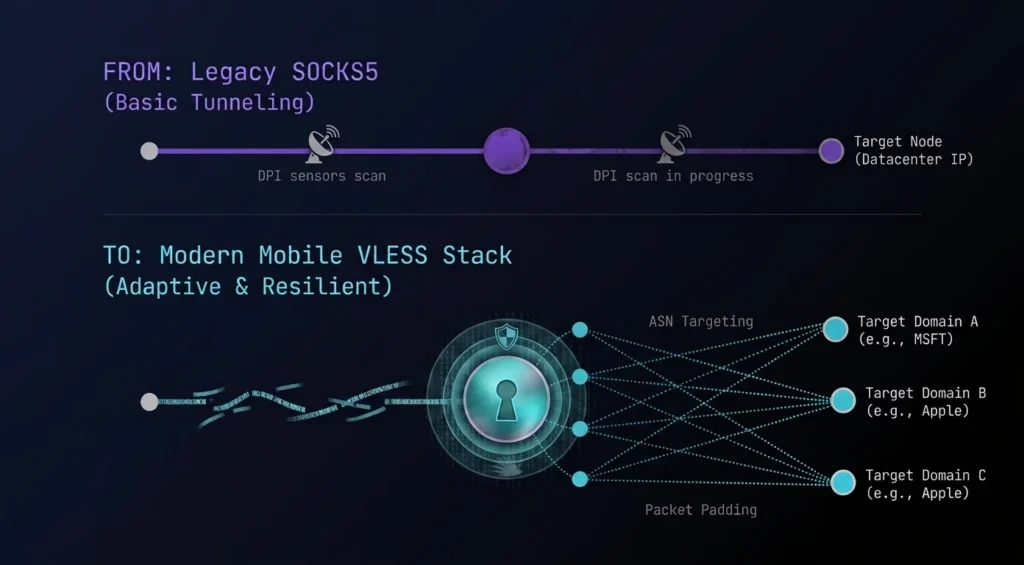
The SOCKS5 protocol remains a reliable industry standard. It works perfectly in trusted corporate networks. However, under strict DPI filtering from local internet providers, pure SOCKS5 becomes vulnerable. Monitoring systems recognize its signatures. Connections drop. Businesses lose revenue.
Data engineers require additional layers of security. Enterprise VLESS proxy infrastructure for data collection solves this. A dedicated VLESS proxy adds an impenetrable transport tunnel over standard mobile protocols. We focus purely on a technical analysis of modern network stacks, demonstrating how Xray-core web scraping setups overcome aggressive censorship.
What is XTLS-Reality? It is an advanced transport mechanism within the Xray-core kernel. It hides proxy traffic. The algorithm masks your data as a legitimate TLS 1.3 connection to authoritative domains like Microsoft or Apple. You no longer manage certificates. Protection against deep packet inspection systems works natively.
How VLESS works: Understanding the network topology
A dangerous myth persists in the industry. Many engineers assume the protocol provides end-to-end encryption from the client directly to the target website. This is a technical error. VLESS operates as a stateless abstraction. It only delivers packets.
Your client software initiates the connection. It wraps the raw request into a VLESS container. The traffic passes through your local internet provider. The connection exists solely on this segment. It terminates at the CyberYozh platform server. Here, VLESS finishes its job. It protects your traffic from strict local ISP filtering. The server hardware decrypts the container.
Then, mobile proxies take over. The server executes a standard network request using a clean cellular IP address. The final website never sees your client device or VLESS cryptography. It only sees a legitimate mobile user. Enterprise VLESS proxy infrastructure for data collection ensures this exact isolation. Transport protection saves you from your local provider. High-quality mobile addresses provide the Trust Rate needed for the final server.
Overcoming DPI restrictions: The Vision algorithm
The XTLS-Reality mechanism intercepts the Client Hello packet. It simulates a handshake on behalf of a third-party domain. Masking the certificate alone is not enough. Analytical systems calculate nested tunnels. They analyze the payload length of the first handshake packets.
The Vision algorithm destroys these size signatures. It adds a random volume of cryptographically indistinguishable padding to packets during the connection phase. Machine learning algorithms lose their reference points. Additionally, Splice technology transfers decrypted packets at the Linux kernel level. This zero-copy data transfer reduces CPU utilization by 40 percent. Enterprise VLESS proxy infrastructure for data collection handles any volume of concurrent requests thanks to this specific optimization.
Future-proofing: Post-quantum cryptography and XHTTP
Quantum computing advancements change the landscape. State systems use a strategy to collect encrypted traffic now and decrypt it later. The Xray-core kernel integrated the ML-KEM-768 algorithm. This hybrid key exchange guarantees absolute cryptographic strength. Proper Post-Quantum XTLS configuration enables these algorithms natively.
Developers executed a conceptual pivot in transport protocols. They abandoned traditional WebSocket implementations. Long-lived connections reveal behavioral patterns. They introduced the SplitHTTP transport layer. XHTTP transport proxy architecture for data extraction provides unprecedented stability. It fragments the payload. The traffic multiplexes through a series of standard HTTP requests. Monitoring systems perceive this as regular web surfing.
Protocol comparison: Choosing the right tool for data collection
Selecting the right protocol depends entirely on your network environment. When evaluating VLESS vs SOCKS5 proxy performance, the main difference is resilience against local ISP blocking. Real-world engineering tests confirm this stability gap under heavy load. The Xray-core web scraping architecture allows you to operate under extreme network censorship using cellular networks. Meanwhile, classic SOCKS5 remains the fastest choice for clean connections.
| Protocol | DPI Protection Level | CPU Load | Pattern Masking | UDP Support | Optimal Application |
| SOCKS5 | None | Minimal | No | Yes | Trusted networks |
| SOCKS5 + TLS | Low SNI leaks | Medium | No | Partial | Basic extraction |
| VMess | Medium active probing | High | Partial | Yes | Legacy systems |
| VLESS + XHTTP | Absolute Vision padding | Low Zero-copy | Full HTTPS masking | Full XUDP | Operating under strict ISP filtering |
The infrastructure paradox: Why custom servers cost more
Companies often attempt to build custom solutions. They rent cloud servers. They configure routing kernels. They fight DNS leaks daily. This wastes valuable DevOps resources.
A secure tunnel is useless with a bad IP address. SelectiCommercial anti-fraud systems instantly block requests originating from data centers. Because VLESS routing is exclusively supported on our cellular nodes, Enterprise VLESS proxy infrastructure for data collection solves this problem comprehensively. Clients receive a synthesis of an impenetrable transport channel and crystal-clear mobile addresses. CyberYozh Data provides ready-to-use pools.
👉 Check your infrastructure fraud score
A reliable XTLS-Reality B2B proxy configuration is hard to maintain internally. Therefore, our Enterprise VLESS proxy infrastructure for data collection eliminates routine engineering tasks. You focus on data analysis. We manage the servers. Dedicated XTLS-Reality B2B proxy setups run flawlessly on our side of the network.Post-Quantum XTLS configuration requires zero effort from your team.ng the right protocol depends entirely on your network environment. When evaluating VLESS vs SOCKS5 proxy performance, the main difference is resilience against local ISP blocking.
Real-world tests on VLESS vs SOCKS5 proxy performance confirm this stability gap under heavy load. The Xray-core web scraping architecture allows you to operate under extreme network censorship using cellular networks. Meanwhile, classic SOCKS5 remains the fastest choice for clean connections.
How to integrate proxies into corporate data pipelines
Distributed automation requires absolute predictability. Managing isolated profiles demands clean mobile traffic. How to overcome DPI for enterprise web scraping is a solved issue. You gain access to millions of addresses via a single endpoint. Integrating VLESS proxies with Python automation takes minutes. The client-side architecture gives you flexible routing control.
In practice, engineers rarely write configurations manually. The platform dashboard provides connection parameters as a standardized URI link. You copy it to the clipboard. Then you import it instantly into any client software. This connection string looks like this:
vless://00000000-0000-0000-0000-000000000000@198.51.100.1:443/?type=tcp&encryption=none&flow=xtls-rprx-vision&sni=[www.microsoft.com](https://www.microsoft.com)&fp=chrome&security=reality&pbk=YOUR_PUBLIC_KEY_PLACEHOLDER&sid=12345678#cyberyozh-mobile-node
Deconstructing this link helps you understand the core mechanics. If we unpack it into the native JSON format used by Xray-core, we get the following machine-readable snippet:
{
  "outbounds": [
    {
      "protocol": "vless",
      "settings": {
        "vnext": [
          {
            "address": "198.51.100.1",
            "port": 443,
            "users": [
              {
                "id": "00000000-0000-0000-0000-000000000000",
                "encryption": "none",
                "flow": "xtls-rprx-vision"
              }
            ]
          }
        ]
      },
      "streamSettings": {
        "network": "tcp",
        "security": "reality",
        "realitySettings": {
          "target": "www.microsoft.com",
          "publicKey": "YOUR_PUBLIC_KEY_PLACEHOLDER",
          "shortId": "12345678",
          "fingerprint": "chrome"
        }
      }
    }
  ]
}
This basic file illustrates the encapsulation logic. It shows exactly how the URI string translates into low-level kernel instructions. The transport layer delegates cryptography to the Reality mechanism. The Vision algorithm tightly controls the data flow. Processor utilization remains minimal even under extreme concurrent loads.
VLESS vs SOCKS5 proxy performance tests show massive latency improvements when using this configuration. Xray-core web scraping allows tools like Puppeteer and Playwright to operate without network interruptions.
Enterprise VLESS proxy infrastructure for data collection changes the industry entirely. XTLS-Reality B2B proxy networks combine post-quantum encryption with advanced transport layers. Building custom server clusters lacks economic viability. Choose reliability. Test the data.cyberyozh.pro API platform today. Gain stable access to premium ISP and LTE addresses. Enterprise VLESS proxy infrastructure for data collection ensures your business operates seamlessly across any commercial network filter.
👉 Deploy private mobile VLESS proxies
What dictates VLESS vs SOCKS5 proxy performance in production?
CPU overhead and packet structure. SOCKS5 is extremely fast but highly visible to network filters. VLESS adds minimal latency thanks to zero-copy Splice technology. It maintains high speed while masking signatures completely.
Does an Enterprise VLESS proxy infrastructure for data collection encrypt the payload?
No. The core protocol is stateless. It relies on the transport layer for security. The XTLS-Reality mechanism handles the actual encryption. This architectural split keeps processor usage remarkably low.
Which clients support Post-Quantum XTLS configuration natively?
Modern clients built on Xray-core v1.8.0 and higher. Popular choices include v2rayN for Windows and Nekoray for cross-platform setups. They parse platform URI links instantly.
How to integrate VLESS proxies with Python automation scripts?
You run a local routing client. It exposes a standard local port. Your Selenium or Playwright script connects directly to this local interface. The client handles the complex network encapsulation in the background.
How does XHTTP transport proxy architecture for data extraction handle Datadome?
The transport architecture secures your traffic against local provider filtering. It makes requests look like standard web browsing. Passing target website checks relies on the clean cellular IP address attached to the node. The protocol itself does not interact with the final website.
Why use an XTLS-Reality B2B proxy if I already have cellular IPs?
Because cellular IPs do not protect your connection from local ISP throttling. Network administrators often throttle repetitive scraping connections. The reality mechanism hides your data gathering pipeline. It looks exactly like standard TLS traffic.