







Selecting the optimal IP infrastructure directly shapes your project architecture. Writing flawless Python code cannot compensate for a network footprint that contradicts your application data. Modern filtering algorithms analyze the transport layer alongside standard browser headers.
Datacenter addresses provide massive throughput for public platforms, but highly protected networks require different solutions. Engineers continuously evaluate mobile vs residential proxies to deploy IP addresses that accurately mirror legitimate human traffic patterns.
TL;DR: Proxy network fundamentals
- The debate of mobile vs residential proxies depends entirely on your target platform’s strictness and your bandwidth consumption.
- A rotating residential proxy routes requests through real household ISP connections.
- Carrier-Grade NAT (CGNAT) allows a single mobile IP to mask thousands of real smartphone users simultaneously.
- An unlimited bandwidth mobile proxy provides a fixed monthly cost for heavy media scraping.
- Understanding how proxy rotation prevents rate limiting is mandatory for large-scale distributed crawling.
The structural advantage of mobile CGNAT architecture
Cellular providers route millions of smartphones through a limited number of IPv4 addresses. Telecom operators use Carrier-Grade NAT (CGNAT) to consolidate massive subscriber clusters under single public IPs.
Routing automation traffic through mobile networks means your requests exit from the exact same public IP address used by thousands of regular subscribers. While your system extracts data, these actual individuals are simultaneously streaming media, browsing feeds, and sending messages. Enterprise firewalls evaluate this blended traffic pattern and assign high trust scores to the carrier IP.
Filtering one CGNAT node disconnects too many legitimate customers, forcing algorithms to let the traffic pass.
The mobile vs residential proxies comparison leans toward mobile hardware when targeting platforms like TikTok or Instagram, as these systems specifically look for cellular signatures.
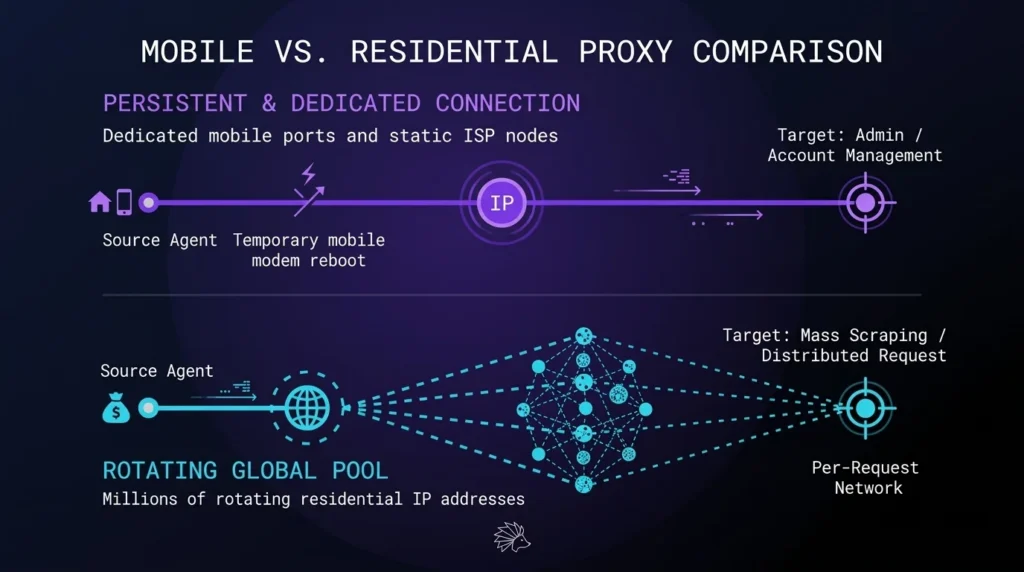
Switching a mobile IP requires the modem to briefly disconnect from the cell tower. This hardware reboot creates a network pause lasting a few seconds.
Automation scripts require exponential backoff algorithms to programmatically handle these connection drops. Managing this physical delay ensures the network traffic maintains carrier-level legitimacy.
Scaling operations with residential proxies
Home broadband connections form the backbone of a rotating residential proxy network. These IPs belong to real household devices provisioned by internet service providers like Comcast or Vodafone.
When comparing mobile vs residential proxies for high volume data extraction, residential pools offer unmatched scalability. CyberYozh maintains a pool of over 100 million residential addresses across 195 countries. You tap into a massive global footprint. This enables granular geo-targeting down to the specific city or ZIP code.
Large-scale market intelligence relies on this distributed architecture to route sequential queries through completely different geographic nodes. An initial request passes through a home router in France, while the subsequent call routes through a device in Tokyo, distributing the load across millions of unique endpoints.
Understanding how proxy rotation prevents rate limiting changes your entire scraping strategy. Target servers monitor request velocity per IP. Hitting a server 100 times a second from a single node triggers immediate rate limits. A rotating residential proxy provides a fresh IP for every single concurrent connection. You scrape localized SERPs or track international pricing without triggering velocity filters.
👉 Rotating residential proxy pools (100M+ IPs) for global data collection.
Bandwidth costs dictate the financial viability of these networks. Residential pools operate on a Pay-As-You-Go model based on gigabytes consumed. Extracting clean JSON data or raw HTML text consumes very little bandwidth. Downloading high-resolution product images or scraping video feeds drains your budget rapidly.
Pricing models: Unlimited traffic vs Pay-per-GB
Infrastructure budgeting depends directly on the volume of extracted data. Evaluating an unlimited mobile proxy vs pay per gb residential plan requires calculating your exact payload sizes in advance.
An unlimited bandwidth mobile proxy charges a flat rate per port. You pay for the dedicated hardware access. You can push terabytes of data through this node 24/7 without incurring additional traffic fees. This model excels for heavy extraction tasks. If your automated agents download massive multimedia files or scrape unoptimized bloated websites, unlimited cellular ports keep your operational costs completely predictable.
Rotating residential networks charge per gigabyte. This model makes perfect sense for lightweight, distributed requests. You need to scrape Amazon pricing across 50 different geographic regions simultaneously. You cannot buy 50 dedicated mobile ports just to check a few localized prices. A rotating residential proxy gives you access to all 50 locations instantly. You only pay for the few megabytes of text data your scripts consume.
ISP proxy vs residential: Maintaining sticky sessions
Certain extraction tasks require persistent identity management within protected e-commerce dashboards. Many modern websites tolerate minor IP changes within the same geographic region, as this is common behavior for mobile internet users.
However, jumping abruptly between different subnets or dropping the connection mid-task frequently triggers security verifications or session logouts.
Standard residential IPs depend on consumer hardware. If the device owner reboots their home router, your connection drops unpredictably. For scenarios requiring absolute session stability without location jumps, engineers evaluate the isp proxy vs residential architecture and select static ISP nodes.
ISP proxies solve this volatility. Datacenters host these static addresses, but regional internet service providers announce the ASN. They offer the blazing speed of a server with the high trust score of a consumer connection. They support extended sticky sessions perfectly. You hold the exact same IP address for hours or days. You manage complex profiles without triggering sudden geolocation changes.
👉 Static residential ISP proxies for persistent sessions and account management.
When determining which proxy is best for scraping e-commerce websites, ISP proxies dominate for tasks occurring behind login walls. They maintain the TCP/IP stack alignment flawlessly throughout long parsing jobs.
Proxy rotation API integration
Modern scraping pipelines demand programmatic control over network routing. You cannot manually click buttons in a dashboard to refresh IPs when managing thousands of concurrent threads.
The proxy rotation api provides this exact control mechanism. CyberYozh integrates REST API endpoints directly into the network layer. Python developers trigger IP changes using simple POST requests.
Your script encounters a soft block or a CAPTCHA challenge. The error handling logic catches the HTTP 403 status code. The code sends a command to the proxy rotation api. The backend infrastructure assigns a clean IP address to your port instantly. The script resumes data extraction seamlessly. This programmatic flexibility makes the choice between mobile vs residential proxies a matter of simple code configuration rather than manual infrastructure management.
Feature comparison matrix
Selecting the best proxy for web scraping depends on matching these technical capabilities to your software requirements.
| Technical Feature | Rotating Residential Proxy | Dedicated Mobile 4G/5G | Static ISP Proxy |
| Trust Score | High | Maximum (CGNAT) | Very High |
| Bandwidth Cost | Pay-per-GB | Unlimited Traffic | Unlimited Traffic |
| Geo-Targeting | Country / City / ZIP level | Country / City / Carrier level | Country / ISP level |
| Session Control | Sticky (up to 24 h) or per-request | Reset via link or API | Permanent static IP |
| Optimal Use Case | Mass distributed scraping | Heavy media & social parsing | Logged-in profile management |
TCP/IP fingerprints: The hardware advantage of mobile ports
Your choice of proxy infrastructure directly impacts transport layer consistency. Advanced platforms incorporate passive network fingerprinting into their initial connection protocols. If a standard proxy node runs on Linux, it formats its MSS and TTL parameters based on its own kernel specifications. Transmitting Windows 11 HTTP headers through this basic node creates an immediate structural mismatch.
CyberYozh resolves this engineering challenge directly at the hardware level: premium dedicated mobile ports feature automated TCP header rewriting at the gateway. This exclusive capability perfectly aligns the transport layer signatures with your application profile without requiring complex local networking configurations.
👉 Unlimited 4G/5G proxies from real carriers.
Transitioning to no-code scraping with Yozh Scraper UI
Testing extraction logic and configuring IP pools via raw JSON payloads introduces unnecessary friction. The Yozh Scraper stack resolves this by integrating a visual interface (Scraper UI) that transforms complex extraction into a true no-code scraping experience.
Users no longer need to write backend routing logic or manually hunt for proxy pool IDs. Developers select the required proxy type and geographic targets directly from dropdown menus linked to the CyberYozh API. The interface allows teams to define extraction rules visually or prompt the AI-driven preset builder to generate the CSS schema automatically.
The backend engine handles IP rotation upon connection drops and maintains sticky sessions, outputting clean structured data without requiring a single line of custom code.
👉 Download Yozh Scraper directly from the GitHub repository.
Final comparison: Matching proxy types to your specific workload
Selecting the correct network architecture depends entirely on your payload sizes and the target platform’s configuration.
Dedicated mobile 4G/5G proxies
- Strengths: Maximum trust scores via CGNAT architecture; flat-rate pricing for unlimited bandwidth.
- Optimal tasks: Managing social media profiles, downloading heavy multimedia files, interacting with strict mobile-first platforms.
- Technical constraints: Brief connection pauses during physical modem resets.
Rotating residential proxies
- Strengths: Access to millions of global endpoints; granular city-level geo-targeting; per-request IP variation.
- Optimal tasks: Mass text extraction, distributed price aggregation, tracking localized search engine results.
- Billing considerations: The pay-per-GB model is highly efficient for text and code, but requires careful budget management when continuously extracting heavy multimedia files.
Static ISP proxies
- Strengths: Datacenter speeds combined with authentic consumer ISP trust signals; absolute session persistence.
- Optimal tasks: E-commerce store administration, navigating authenticated dashboards, managing permanent profiles.
- Technical constraints: Fixed IP addresses cannot support high-frequency concurrent scraping operations due to velocity limits.
What makes a rotating residential proxy different from a VPN?
A VPN assigns a single static IP from a datacenter. A rotating proxy routes your individual HTTP requests through millions of different real household devices, providing a unique IP for every single connection to manage rate limits.
How exactly do you choose the best proxies for web scraping?
Analyze your target and bandwidth. Use rotating residential IPs for mass crawling of public text data across many locations. Use dedicated mobile IPs for scraping social platforms or downloading heavy media files.
Why are mobile vs residential proxies constantly compared?
They represent the two highest trust levels available. Mobile IPs place you within massive CGNAT carrier pools. Residential IPs provide access to millions of unique global consumer endpoints. Both pass standard datacenter filters easily.
How does an unlimited bandwidth mobile proxies reduce operational costs?
You pay a fixed daily or monthly fee for the physical port rather than paying for data consumed. If your scraping script downloads 500GB of video content, your cost remains exactly the same.
When should I use an ISP proxy vs residential for my tasks?
Use static ISP proxies when you need to stay logged into an account for days without the IP changing. Use rotating residential proxies when you need to scrape 10,000 different search results without triggering connection limits.
How do I integrate a proxy rotation api into my Python code?
You configure your requests or aiohttp library to handle network exceptions. When your script detects a connection drop, it fires a POST request to the provider’s API endpoint, waits a few seconds for the new IP, and resumes the parsing loop.