





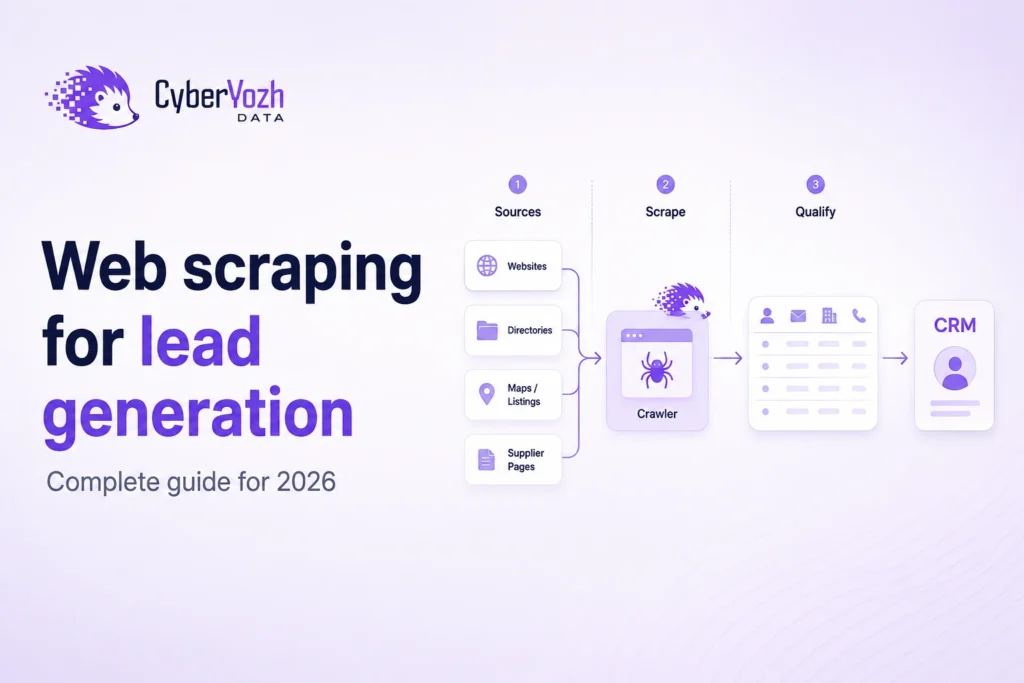
Web scraping for lead generation can turn hours of manual prospect research into a structured, repeatable data workflow. Instead of visiting company websites, directories, marketplace listings, and local business pages one by one, a scraper can collect relevant public information and prepare it for qualification.
But collecting more rows does not automatically create better leads. A useful workflow starts with a clear ideal customer profile, collects only the fields needed to evaluate those companies, and keeps enough source information to verify where every record came from.
If you are new to the terminology, start with CyberYozh’s guide to what web scraping means and how it works. The important distinction is that scraping extracts information, while crawling discovers the pages from which that information can be collected.
Quick answer: Web scraping for lead generation is the automated collection of publicly accessible business information that helps a company discover, qualify, segment, or enrich prospective customers. A reliable process is: define the ICP → find relevant sources → crawl the right pages → extract structured fields → validate and deduplicate → score the records → send qualified leads to the CRM.
Build your lead collection infrastructure: If your prospect research depends on regional results, distributed requests, or websites that limit repeated traffic from one IP, explore CyberYozh proxy infrastructure for lead generation workflows. Choose the network layer according to the data source and geography rather than adding proxies automatically.
What web scraping for lead generation actually does
Lead generation web scraping is best treated as a research layer. It finds and structures information that can help determine whether a business matches your target market before a sales representative spends time researching it manually.
Imagine a software company targeting independent logistics businesses in Germany. Its scraper might collect the company name, website, city, services, number of locations, public contact channels, hiring pages, and technologies mentioned on the site. Those fields can then be normalized and scored against the ICP.
The process normally contains three separate jobs:
- Discovery: identifying websites, directories, category pages, seller listings, or other public sources worth visiting.
- Extraction: turning selected page elements into structured fields.
- Qualification: cleaning, deduplicating, enriching, and scoring those fields before a record reaches sales.
Keeping these stages separate makes problems easier to diagnose. If the number of leads suddenly drops, you can determine whether source discovery failed, page structure changed, or qualification rules became too strict.
What data should you scrape for lead generation?
The best lead dataset is not the one with the most columns. It is the one containing enough information to make a useful qualification decision.
Define the desired output before launching the crawler. That prevents the common problem of collecting dozens of fields that nobody on the sales or marketing team actually uses.
| Data category | Examples | Why it matters |
| Company identity | Name, domain, country, location | Establishes the business record |
| Business fit | Industry, services, product categories | Shows whether the company matches the ICP |
| Scale signals | Locations, catalog size, job listings | Helps estimate account potential |
| Change signals | New products, jobs, offices, pricing | Can indicate a timely sales opportunity |
| Public contact data | Business email, contact page, phone | Provides an appropriate outreach path |
| Source evidence | URL, page title, capture date | Makes the record auditable |
A field should have a purpose. If you cannot explain how a data point will influence qualification, segmentation, or outreach, it probably does not belong in the first version of the scraper.
Collect less, validate more: A dataset of 5,000 verified companies with clear source URLs is usually more useful than 100,000 records filled with duplicate domains, obsolete contact details, and unexplained fields.
How to build a web scraping for lead generation pipeline
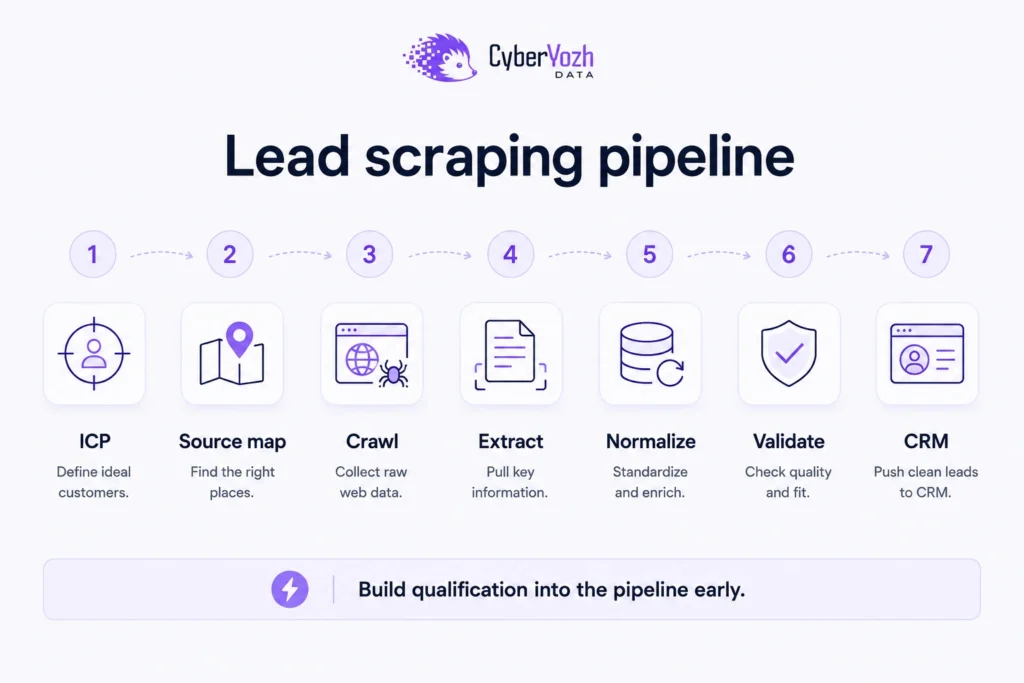
A scalable pipeline needs more than a script that downloads HTML. It needs clear boundaries around where data comes from, how requests are made, how failed extractions are handled, and what happens before records reach the CRM.
CyberYozh’s guide to running web scraping automation reliably covers the broader production problem of crawling, retries, scheduling, proxy handling, and monitoring.
1. Define your ICP before writing extraction rules
Start with the business decision.
A lead generation team targeting Shopify agencies might require fields such as company name, country, website, agency specialization, public case studies, industries served, and estimated client profile. A company targeting Amazon sellers will need a different schema.
Write the schema first. A basic record could look like:
company_name
domain
country
industry
service_type
public_contact
source_url
captured_at
fit_score
This makes it easier to build selectors and validation rules around information the team actually needs.
2. Create a source map
Different sources answer different questions.
Company websites may provide service information. Public directories can help discover businesses within a location or industry. Marketplace listings may reveal active sellers or brands. Job pages can indicate hiring and expansion. Public association directories can identify companies in specialized markets.
Do not send the same generic crawler across every source. Document what each source contributes and what paths are relevant.
3. Control the crawl
A crawler should have boundaries such as allowed domains, URL patterns, maximum depth, maximum pages, request rates, and exclusion rules.
The Robots Exclusion Protocol provides a standard way for service owners to publish crawler instructions in robots.txt. It is important to understand that robots rules are crawler instructions, not a general authorization system.
Use conservative request rates even when a source does not publish a specific limit. A scraper that repeatedly overwhelms the target is badly designed regardless of how many proxies are available.
A proxy does not replace crawl discipline: Rate limits, scope controls, retries, exclusions, and permission boundaries should exist before proxy rotation is added. More IP addresses do not make an irresponsible crawler responsible.
4. Extract structured fields
Once the crawler finds the right pages, the extraction layer turns page content into useful fields.
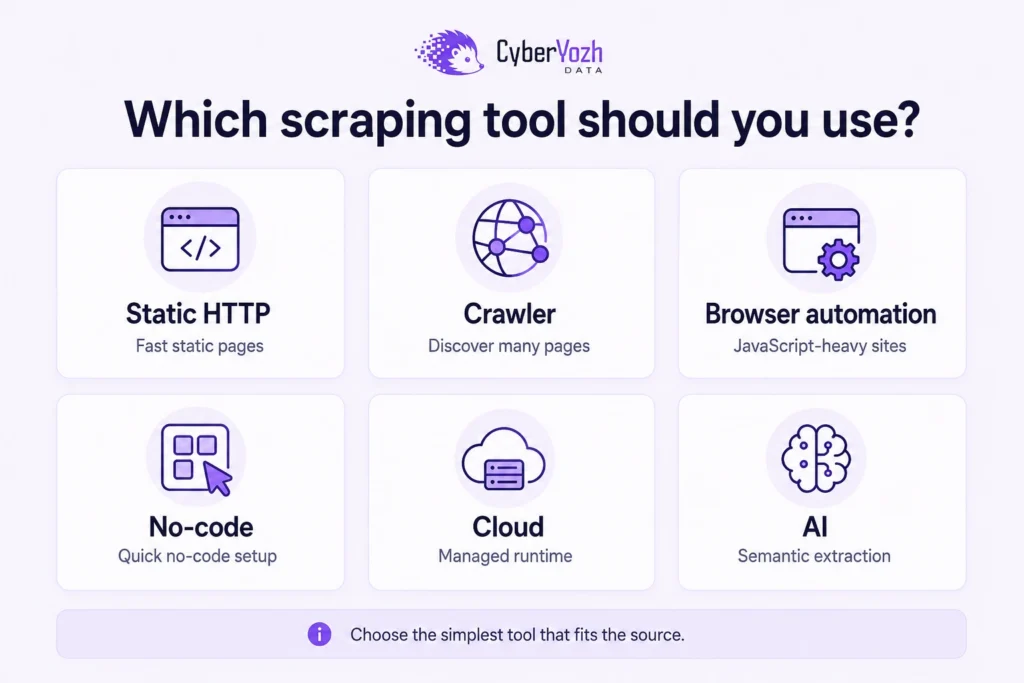
Static sites may only require HTML parsing. JavaScript-heavy sites may require a browser. Some sources may offer an API that is more reliable than parsing the website itself.
If an API could simplify the workflow, compare the available options before building custom page extraction. This guide to choosing an API for web scraping and structured extraction explains where APIs, custom scrapers, browser automation, and proxies fit.
Do not assume the heaviest tool is the best one. If the required data is available in an ordinary HTTP response, launching a browser for every page adds unnecessary complexity and cost.
5. Normalize the output
Scraped data is rarely consistent enough to send directly to a CRM.
Company names may use different legal suffixes. Phone numbers can appear in several formats. Locations may use city names, abbreviations, or country codes. The same domain may occur in multiple directories.
Normalize these fields before deduplication. Keep the raw value as well when it helps with debugging or auditing.
6. Validate and score the records
A successful HTTP response does not mean the extracted data is correct.
Check whether required fields exist, whether values fit the expected type, whether pages were actually product or company pages, and whether obvious placeholders have been captured accidentally.
Then score leads against the ICP. Geography, service type, company size, product range, hiring activity, or other business signals can determine whether the record deserves further research.
Best Python tools for web scraping for lead generation
Python is popular for lead generation web scraping because the same ecosystem can handle HTTP requests, HTML parsing, crawling, browser automation, and data cleaning.
The best tool depends on what the source requires.
| Tool | Best use | Main consideration |
| Requests | APIs and static pages | Does not render JavaScript |
| Beautiful Soup | HTML parsing and cleanup | Needs a separate fetching layer |
| Scrapy | Larger crawling projects | More setup than a small script |
| Playwright | JavaScript-rendered pages | Uses more resources than HTTP requests |
| Selenium | Browser automation and existing Selenium stacks | Often heavier than direct requests |
| pandas | Cleaning and deduplication | Used after collection rather than for crawling |
The official Python Requests documentation explains how request headers, parameters, responses, and other HTTP basics work.
When the source needs a browser, CyberYozh has a practical guide to using proxy infrastructure with Playwright scraping sessions. Selenium-based teams can instead follow the residential proxy setup for Selenium automation.
Use the simplest extraction method that works: Direct HTTP is easier to scale and debug. Browser automation is worth the extra cost when the content you need is generated or revealed through JavaScript.
Headers for web scraping: what actually matters?
Headers are normal request metadata. They tell a server about the client, acceptable content types, preferred languages, authentication, and related request context.
Common examples include User-Agent, Accept, Accept-Language, Content-Type, and, where legitimately required, Authorization.
Headers should be internally consistent. If your workflow is collecting French storefront information from a French region, the location, language settings, expected currency, and parsing logic should agree.
Do not think of headers as a collection of random values that need to be constantly changed. Randomization can make a dataset harder to reproduce and make failures harder to debug.
Web scraping for ecommerce lead generation
Web scraping for ecommerce is useful for more than price monitoring. Public marketplace and store data can help identify brands, sellers, suppliers, distributors, and other businesses that match a sales profile.
An agency may identify stores with large catalogs but weak localization. A logistics company may find brands expanding into new regions. A SaaS provider may prioritize sellers based on assortment size or marketplace activity.
For the technical side, CyberYozh’s guide to building a production e-commerce scraper explains how to structure collection pipelines for catalogs and marketplace data rather than relying on one-off scripts.
Collect localized ecommerce data: If qualification depends on the storefront, price, catalog, or seller information visible from a particular market, use CyberYozh e-commerce proxy infrastructure for localized collection to align the network location with the market being researched.
When should a lead generation scraper use proxies?
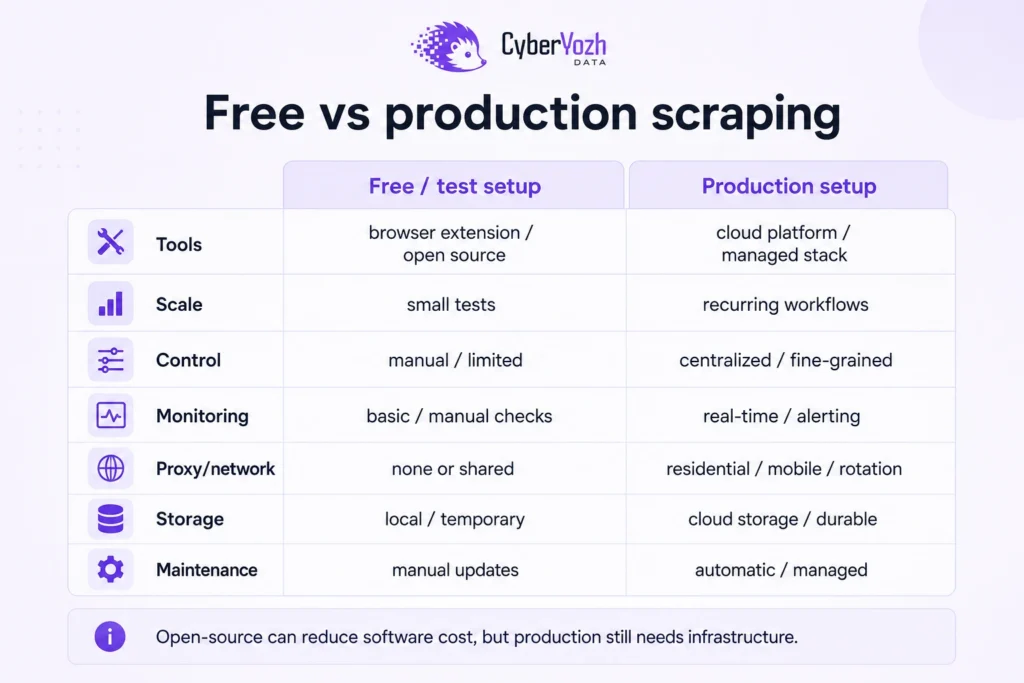
Not every scraper needs a proxy network. Small jobs involving public pages may work perfectly well from a normal server connection.
Proxies become more useful when results vary by geography, a legitimate crawl needs to distribute requests, or a source enforces practical limits per IP.
The correct network depends on the task. CyberYozh’s guide to choosing the best proxy type for web scraping explains the differences in more depth.
Datacenter proxies can be efficient for high-speed public-data workflows where residential network characteristics are unnecessary.
Rotating residential proxies are useful for larger localized collection jobs that benefit from a distributed residential network. Learn how a rotating residential proxy works for scraping workloads before deciding how frequently the address should change.
Static residential proxies can fit workflows where a consistent IP and location must be maintained for longer periods.
Mobile proxies are generally unnecessary for ordinary company-directory scraping. They make more sense when the target itself is mobile-first or the research genuinely depends on carrier-network behavior.
Understanding proxy rotation and session behavior is particularly important. Per-request rotation, timed rotation, and sticky sessions can produce very different results.
Rotation should match the unit of work: If several requests belong to the same logical session, changing location or identity midway through that session can create inconsistent data instead of improving reliability.
How CyberYozh fits into a lead generation data pipeline
A lead generation workflow usually involves more than acquiring IP addresses. It needs page discovery, extraction, structured output, retries, validation, and eventually an integration with whatever system will use the data.
CyberYozh’s current scraping stack includes open-source crawler and scraper tooling alongside proxy infrastructure. This makes it possible to treat network access and extraction as parts of one workflow rather than building a chain of disconnected tools.
A simple architecture looks like:
Target criteria → source list → crawl → scrape → normalize → validate → score → CRM
For teams currently combining several vendors for different parts of the workflow, the Data CyberYozh article on why access and data tools work better as one connected infrastructure stack explains the operational argument for reducing fragmentation.
If a lightweight browser extension is no longer enough for a repeated data job, compare more robust approaches in CyberYozh’s Instant Data Scraper alternatives guide.
The objective is not to use every tool available. It is to reduce the number of fragile handoffs between discovery, access, extraction, and downstream processing.
Common mistakes in lead generation web scraping
Most problems appear after the first successful scrape, not during it.
Teams often collect too much data, fail to retain source URLs, mix companies and contacts without a consistent identifier, push unvalidated results directly into the CRM, or change geographic conditions between collection runs.
Another frequent mistake is measuring success by the number of records collected. A lead dataset should instead be evaluated by coverage, accuracy, freshness, duplicate rate, qualification rate, and how many records are actually useful to the team consuming them.
Monitor data quality, not just scraper uptime: A scraper can return HTTP 200 responses all day while silently extracting blank titles or the wrong page element. Validate the output itself.
Turn web data into a usable lead pipeline
Web scraping for lead generation works when the entire pipeline is designed around data quality rather than raw volume.
Define the ICP before you scrape. Select sources that contain the signals you actually need. Crawl narrowly, extract structured fields, validate the results, keep every source traceable, and only add proxy infrastructure where scale or localization justifies it.
Build a controlled scraping workflow: Explore CyberYozh web scraping infrastructure for proxies, automation, and structured data collection when you are ready to move from isolated scraping scripts to a more repeatable collection pipeline.
FAQs about web scraping for lead generation
These questions cover the main technical and operational issues teams face when moving from manual prospect research to automated public-data collection.
What is web scraping for lead generation?
Web scraping for lead generation is the automated collection of public business information used to discover, qualify, segment, or enrich potential customers. The strongest workflows keep the source URL and timestamp with the extracted record.
Is web scraping for lead generation legal?
There is no universal answer. Legality and permitted use can depend on the jurisdiction, type of data, access method, contractual terms, privacy rules, target-site policies, and intended use.
Review the relevant rules for each project and obtain legal advice when the workflow involves regulated, sensitive, personal, authenticated, or otherwise high-risk data.
What are the best Python tools for web scraping?
Requests and Beautiful Soup are good for simple pages. Scrapy is better suited to larger crawl projects, while Playwright and Selenium are useful when browser rendering is necessary.
The best stack is the simplest one that consistently produces the required data.
What headers should I use for web scraping?
Typical headers include User-Agent, Accept, Accept-Language, and Content-Type. Authorization should only be supplied where you legitimately have credentials or an access token.
Keep request metadata consistent with the real collection environment instead of randomizing values unnecessarily.
Do I need proxies for lead generation web scraping?
No. Small public-data jobs can often run without them. Proxies become useful when results vary by location, requests must be distributed responsibly across a larger collection job, or the source imposes practical per-IP restrictions.
How can web scraping for ecommerce generate leads?
Ecommerce scraping can help discover sellers, brands, distributors, store locations, categories, assortment sizes, and other public commercial signals. Those signals can then be matched against your ICP.
How often should lead data be scraped?
Refresh frequency should depend on how quickly the underlying field changes. A company address may stay stable for months, while jobs, product catalogs, prices, and promotions can change much faster.