







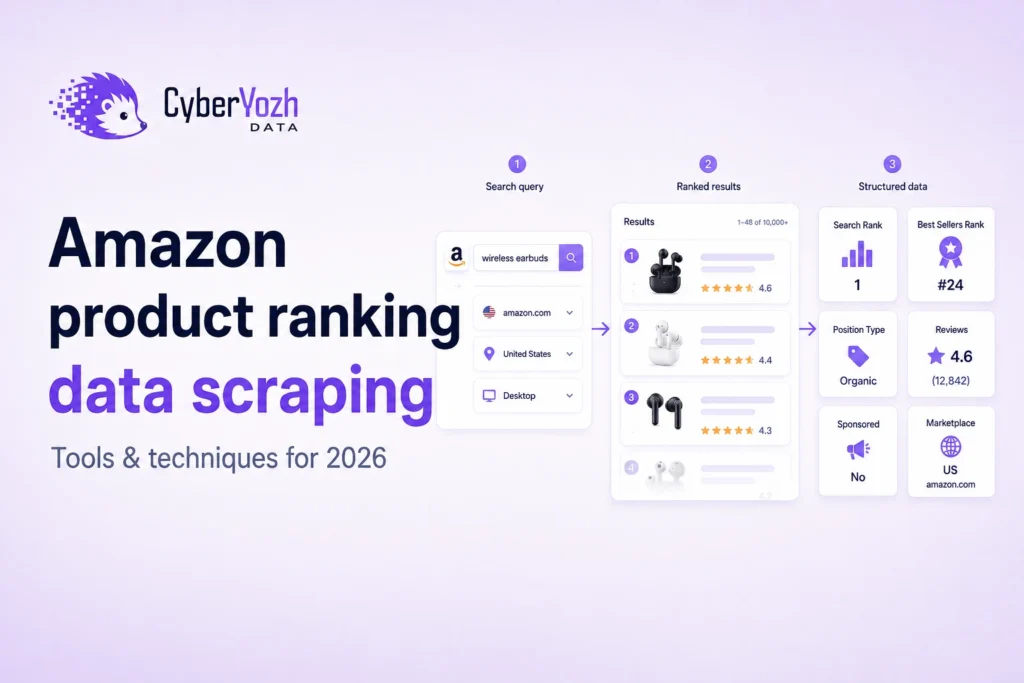
The hardest part of Amazon product ranking scraping is not collecting a number. It is knowing what that number actually represents.
Amazon search position, organic position, sponsored placement, and Best Sellers Rank are different metrics. If they all end up inside one generic rank column, the dataset can look clean while telling you very little.
For most custom Amazon monitoring workflows, you also do not need to stitch together a scraper, separate crawler, browser tool, proxy vendor, and several small utilities before you can start collecting data. CyberYozh Data brings the scraping and crawling layer together, while the wider CyberYozh infrastructure can support location-aware collection when the project needs it.
If you are new to the process, start with the basics of web scraping and structured data extraction before building a ranking monitor.
Quick answer: For Amazon ranking data, define the metric first, then use CyberYozh Yozh Scraper to extract the Amazon product or search data you need. Add Yozh Crawler when page discovery or larger crawl jobs are required, and connect the appropriate CyberYozh proxy infrastructure when marketplace location matters. Store ASIN, marketplace, query or category, rank type, sponsored status, location, timestamp, and source with every observation.
Start the Amazon scraping workflow in CyberYozh Data: Use CyberYozh Data as the extraction layer for structured marketplace data instead of building the workflow from disconnected scraping tools.
What is Amazon product ranking data
Amazon product ranking data describes where a product appears relative to other products under a clearly defined ranking system. The important part is defining that system before you start collecting historical data.
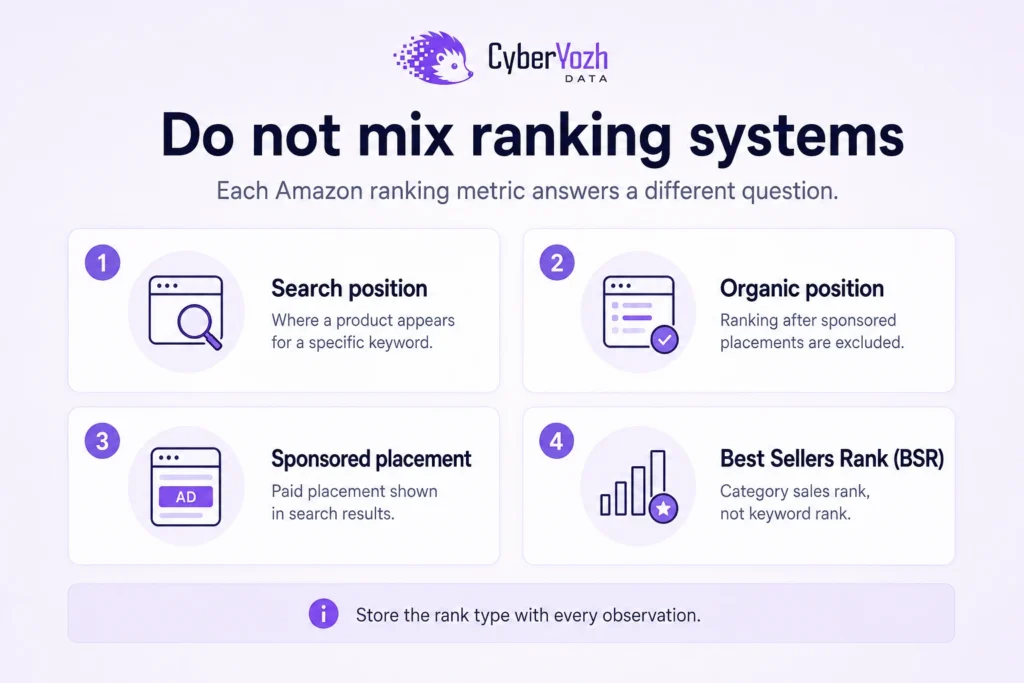
For Amazon research, you will usually work with search position, organic search position, sponsored placement, Best Sellers Rank, or a combination of these metrics.
Amazon search position
Search position records where an ASIN appears for a particular Amazon search query.
A useful observation might contain:
- query: wireless keyboard;
- ASIN;
- Amazon marketplace;
- visible page position;
- organic position;
- sponsored: yes/no;
- location;
- price;
- availability;
- timestamp.
Without the query, marketplace, and capture time, a search position is difficult to compare reliably.
Amazon Best Sellers Rank
Best Sellers Rank, or BSR, is different. It represents sales-rank information within Amazon categories or browse nodes rather than keyword search position.
Amazon’s official Creators API documentation for browse-node information documents sales-rank information associated with browse nodes.
Do not mix ranking systems: Organic position 6 and category sales rank 6 are not equivalent. Store rank_type, category context, and the observed value separately.
The same principle applies across other marketplaces. CyberYozh’s Walmart scraping infrastructure shows how marketplace, extraction, location, and network conditions fit into one collection workflow.
What data should an Amazon ranking scraper collect
The right schema makes Amazon ranking data easier to compare, debug, and reuse. Collect enough context to explain each observation without filling the dataset with fields that have no analytical purpose.
For most product-ranking and competitor-monitoring projects, the following fields are a solid starting point.
| Field | Why it matters |
| ASIN | Identifies the exact product |
| Search query | Defines the keyword being measured |
| Marketplace | Separates Amazon regions |
| Rank type | Search, organic, sponsored, BSR, or another metric |
| Page position | Records visible placement |
| Organic position | Separates organic visibility |
| Sponsored flag | Prevents advertising from being counted as organic |
| Category/browse node | Adds context to BSR |
| Price | Supports competitor analysis |
| Availability | Helps explain disappearing products |
| Rating | Provides product-performance context |
| Review count | Adds another competitive signal |
| Location | Records geographic conditions |
| Timestamp | Enables historical tracking |
| Source URL | Makes the observation auditable |
If you plan to monitor multiple marketplaces, location should be part of the schema from day one.
Keep marketplace location consistent: For research across different Amazon countries or regional storefronts, use CyberYozh marketplace data collection infrastructure so the network location is part of the collection design rather than an afterthought.
Why use CyberYozh Data for Amazon scraping
CyberYozh Data is particularly useful when Amazon collection is not a one-time export. It gives you a scraper and crawler foundation you can build into a repeatable marketplace-data pipeline.
Instead of treating scraping as one isolated request, think of the workflow as:
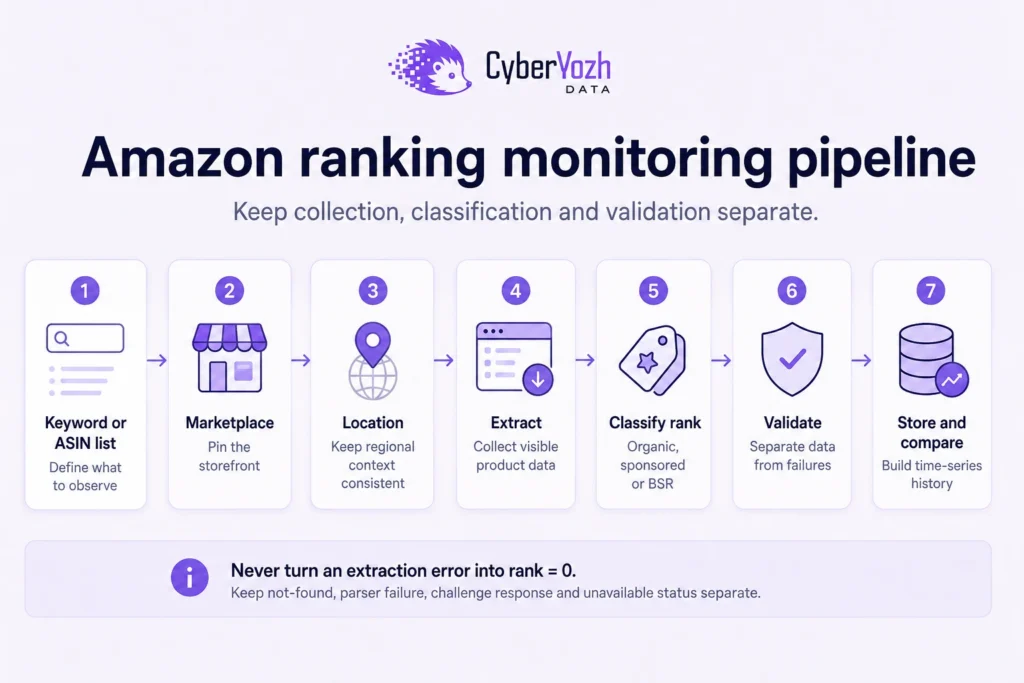
Amazon query or ASIN → Yozh Scraper → structured output → validation → historical database → reporting or alerts
Yozh Scraper handles extraction. When a project expands beyond predefined URLs and needs page discovery, Yozh Crawler can handle the crawling layer.
Current Yozh Crawler documentation describes controls for crawl scope, page limits, retries, rate limiting, browser rendering, structured extraction, screenshots, and proxy-backed collection.
This matters because Amazon monitoring quickly becomes an infrastructure problem once you move beyond a few manual checks.
When Yozh Scraper is enough
Use Yozh Scraper when you already know the product page, search query, or page you want to extract.
Typical jobs include:
- collecting Amazon product information;
- monitoring search results;
- extracting product prices;
- recording rating and review-count changes;
- collecting availability;
- building repeated ASIN snapshots.
You do not need to build a completely separate scraper API just to make those observations.
When to add Yozh Crawler
Add the crawler when the collection job also needs discovery.
For example, you may need to start from a marketplace or category page, follow eligible product links, enforce crawl boundaries, and send discovered pages through the scraper.
That separation makes the system easier to manage: the crawler finds the pages, and the scraper extracts the data.
How to get started with Yozh Scraper for Amazon
The practical workflow is simpler than assembling a custom stack from scratch. Define the Amazon data you need, configure the scraper, add the marketplace network conditions where necessary, and then validate a small batch before scaling.
The existing CyberYozh Open Scraper setup is the best place to follow the scraper configuration workflow.
A basic process looks like this:
- Choose the Amazon observation. Decide whether you need product data, keyword results, price, availability, review signals, or several fields together.
- Set the marketplace. Keep Amazon US, UK, Germany, France, Japan, and other marketplaces separate.
- Configure the extraction. Use Yozh Scraper for the required product or search data.
- Add a proxy when location matters. The network should match the marketplace you intend to observe.
- Run a small batch. Check the result manually before collecting hundreds or thousands of observations.
- Normalize the output. Standardize timestamps, prices, marketplace codes, sponsored flags, and rank types.
- Store the history. Once the schema is stable, schedule repeated collection.
Callout — Validate before scaling: A scraper that returns data is not automatically returning the right data. Manually compare an early sample with the source before treating the output as a historical ranking dataset.
Best Amazon product ranking data scraping tools for 2026
If the goal is a repeatable custom Amazon data pipeline, CyberYozh Data should be the first option to evaluate. Other tools can still be useful, but they solve narrower problems or introduce another vendor into the stack.
1. CyberYozh Yozh Scraper and Yozh Crawler
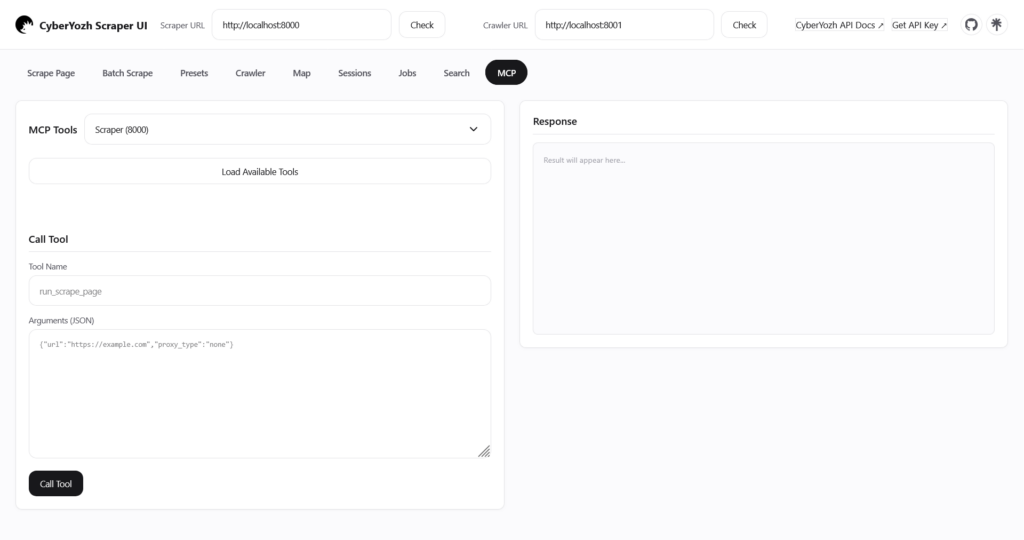
This is the strongest fit for the workflow covered in this article because the scraper and crawler can operate as parts of the same data-collection stack.
Use Yozh Scraper for structured extraction and Yozh Crawler when the workflow also needs controlled page discovery.
Best for: Amazon product research, rankings, price monitoring, marketplace data, repeated scraping jobs, and teams that want more control over the extraction pipeline.
2. Scrapy
Scrapy is a strong Python framework if your team wants to build its own crawling logic and pipelines.
The trade-off is engineering work. You still need to maintain spiders, selectors, middleware, proxy handling, monitoring, and source-specific changes yourself.
If your existing system already uses Scrapy, CyberYozh proxy support for Scrapy can handle the network layer without forcing you to rebuild the crawler.
3. Playwright
Playwright is useful when the browser-rendered version of a page matters. This can include JavaScript-loaded content, rendered Amazon result modules, or screenshot-based verification.
For teams that already use browser automation, setting up CyberYozh proxies with Playwright keeps the browser session and chosen marketplace region aligned.
If you are still deciding whether a browser is necessary, understanding how a headless browser works can help avoid running full browser sessions for pages that Yozh Scraper can handle more simply.
4. Browser extensions and managed scrapers
Chrome extensions, Apify Actors, Octoparse, Bright Data scrapers, and similar products can still be useful for particular jobs.
A browser extension is convenient for a quick export. A managed cloud scraper can be useful if you want an external provider to operate more of the infrastructure.
For CyberYozh users, however, these should be considered alternatives rather than the automatic starting point. If Instant Data Scraper or another lightweight extension has become too limited, the CyberYozh Data comparison of Instant Data Scraper alternatives explains when it makes sense to move to a more controllable scraping setup.
One successful export is not a production benchmark: For recurring Amazon research, repeatability, structured output, retries, validation, proxy control, and monitoring matter more than how quickly a tool creates its first CSV.
Can you scrape Amazon product ranking data for free
You can build and test an Amazon data workflow without immediately buying a large commercial scraper subscription. Open-source scraping software makes that much more practical.
CyberYozh’s scraper/crawler approach is particularly relevant here because you can use open-source tooling rather than being locked into a closed scraping SaaS for every request.
“Free” does not mean production has no cost. At scale, you still need compute, bandwidth, storage, maintenance, monitoring, and potentially proxy traffic.
What about Amazon scraper GitHub projects
GitHub contains many Amazon scraper scripts, Scrapy projects, Playwright examples, parsers, and Selenium projects.
These can be useful for learning, but one old GitHub script is not the same as maintaining a real collection pipeline. Check when it was updated, whether selectors still work, what marketplaces are supported, and how failures are reported.
For a project you intend to operate repeatedly, using CyberYozh Data gives you a more coherent starting point than assembling unrelated GitHub snippets.
What about free Chrome extensions
Extensions are good for small manual exports. They become awkward when you need hundreds of keywords, recurring monitoring, different locations, retries, error states, or scheduled jobs.
The larger the project becomes, the stronger the case for moving the actual extraction into Yozh Scraper.
Amazon review scraping with CyberYozh Data
Amazon review scraping is related to ranking analysis, but the two datasets should not be confused.
Ranking scraping tells you where a product appears. Review scraping captures public review signals that can later be used alongside ranking, price, and availability data.
A review-oriented schema might contain:
asin
review_rating
review_date
review_title
review_text
variant
captured_at
Yozh Scraper can be used as the extraction layer when the required public review data is available to the configured workflow. You can then aggregate those records into measures such as review count, average rating, or review velocity before joining them to ranking observations.
That creates a richer competitive dataset:
organic rank + BSR + price + availability + rating + review count
Keep raw reviews separate from rank history: Join aggregated review metrics later rather than putting individual review records inside the ranking table.
Techniques for reliable Amazon ranking scraping
A good scraper still produces poor research if every observation is collected under different conditions. The techniques below are about making the dataset comparable.
Pin the marketplace
Do not combine Amazon US, Amazon UK, Amazon Germany, or another marketplace without explicitly recording which marketplace produced each observation.
Price, currency, inventory, categories, and search visibility can all change between marketplaces.
Keep the network location consistent
If one measurement comes from New York and the next comes from another country, you may be comparing different storefront conditions.
CyberYozh’s Amazon proxy infrastructure is useful when you need the observation to reflect a defined Amazon region.
Separate sponsored and organic results
A product may be visible because it is sponsored even when its organic position has not changed.
Store both page_position and organic_position when that distinction matters, and include a sponsored flag rather than silently removing advertising placements.
Preserve timestamps and source evidence
Every observation should include a capture time. For troubleshooting, it is also useful to retain the source URL and enough evidence to determine what the scraper actually saw.
CyberYozh’s approach to web scraping automation, retries, and recurring jobs becomes particularly important once Amazon collection runs on a schedule.
Monitor extracted values, not only request status: HTTP 200 does not prove the parser found the correct product title, price, rank, or review field.
How proxies fit into a CyberYozh Data Amazon workflow
The scraper collects the data. The proxy controls the network location and, when appropriate, how traffic is distributed.
They should be designed together when geography matters.
A rotating residential proxy can support larger distributed public marketplace collection jobs. For a sequence of related requests that should stay together, understand proxy rotation and sticky sessions before changing the IP on every request.
Expand beyond one Amazon storefront: Use CyberYozh ecommerce proxy infrastructure when the same Yozh Scraper workflow needs to collect marketplace products, prices, sellers, or availability across different geographic markets.
The point is not to rotate as aggressively as possible. The goal is to create a stable and reproducible observation.
Web scraping competition data extraction techniques
Amazon rankings become more valuable when they are combined with other public competitive signals. Yozh Scraper can form the extraction layer for a wider competitor-monitoring dataset rather than running a separate scraper for each field.
Useful fields can include:
- search position;
- BSR;
- sponsored position;
- product price;
- discount;
- availability;
- rating;
- review count;
- seller;
- category;
- timestamp.
CyberYozh’s price scraping infrastructure shows how repeated pricing observations fit into the same type of monitoring architecture.
Correlation is not causation: A product ranking change that happens after a price or review change is worth investigating, but the dataset alone does not prove that one caused the other.
Which proxy type should you use with Yozh Scraper
The right proxy depends on the collection job rather than Amazon alone.
Datacenter proxies can be efficient where the target and collection method do not require residential network characteristics. Rotating residential proxies are useful for distributed and localized marketplace collection. Static residential proxies are a better fit when a session needs to maintain one consistent IP and region.
Mobile proxies are more specialized and usually unnecessary for ordinary Amazon product-rank monitoring.
The CyberYozh comparison of proxy types for scraping can help you match the proxy to the actual workload.
Amazon product data scraping best practices and ethical guidelines
CyberYozh Data should be used for responsible data collection. Having a scraper capable of collecting information does not remove the need to consider how that information is accessed and used.
Public visibility, contractual terms, crawler instructions, API terms, copyright, privacy requirements, authentication, and applicable law are separate considerations.
The IETF Robots Exclusion Protocol defines the standardized robots.txt mechanism websites can use to communicate crawler rules.
Good operating rules include:
- Collect only the data required for the research.
- Review applicable terms and crawler instructions.
- Keep request rates reasonable.
- Avoid unnecessary personal or private data.
- Do not automate protected or authenticated areas without authorization.
- Record source, time, marketplace, and collection method.
- Treat request failures separately from genuine product changes.
Public does not mean unrestricted: A product page being visible in a normal browser does not automatically define what automated collection volume or access method is permitted.
How CyberYozh Data fits into a complete marketplace pipeline
For larger projects, the advantage of CyberYozh is not simply that it has a scraper. It is that scraping can sit alongside crawling, proxy infrastructure, browser automation, and downstream data workflows without forcing the team to stitch together a new vendor for every step.
A practical architecture looks like:
ASINs/queries → Yozh Scraper → Yozh Crawler where needed → CyberYozh proxy → structured records → validation → database → reports
If you later add AI classification or analysis to the extracted dataset, CyberYozh also has infrastructure for AI web scraping and data collection.
And if your current workflow has already turned into several disconnected scraping and infrastructure subscriptions, the Data CyberYozh article on bringing proxy and supporting tools into one operational ecosystem explains the wider platform approach.
Build Amazon ranking data with one connected scraping stack
The best Amazon scraping workflow is not the one containing the most tools. It is the one that gives you reliable observations without creating unnecessary infrastructure complexity.
Start with Yozh Scraper. Add Yozh Crawler when discovery is needed. Add the appropriate CyberYozh proxy when geography or request distribution matters. Then normalize the data, preserve every observation’s context, and build the monitoring layer on top.
That is a cleaner approach than buying a scraper, separate crawling service, separate proxy network, and another automation platform before you have even validated the dataset.
Move from Amazon scraping tests to a production data pipeline: Use CyberYozh’s framework for building a production-ready ecommerce scraper to connect extraction, crawling, proxy control, validation, and storage into one repeatable marketplace workflow.
FAQs about Amazon product ranking data scraping tools and techniques
These questions cover the main search intents around Amazon scrapers, free tools, APIs, Python, reviews, extensions, and CyberYozh Data.
What is the best tool to scrape data from a website?
For Amazon specifically, the best tool depends on whether you need API catalog data, static HTML, rendered search results, reviews, screenshots, or broad crawling. Use the least complicated tool that reliably captures the required observation.
What is the best free Amazon product scraper?
For a small test, an open-source Python project or Chrome extension may be enough. There is no universally best free production scraper because production collection also requires runtime, monitoring, maintenance, and often network infrastructure.
Is there an Amazon scraper Chrome extension?
Yes, browser-extension scrapers exist and search results surface several options. They are most useful for small interactive exports rather than large scheduled monitoring pipelines. Always review the extension’s permissions and current support before installing it.
Can I scrape Amazon reviews with Python?
Python can be used for HTML parsing, crawling and browser automation. Whether a particular approach is appropriate depends on how the required review data is exposed and the rules applying to the collection. You can use Yozh Scraper for the extraction layer and Python for normalization, analysis, storage, scoring, visualization, or other processing around the collected data.
Are Amazon review scraper GitHub projects reliable?
Some are useful starting points, but reliability varies. Check recent commits, open issues, marketplace support, selectors, error handling and whether the project still works with the current Amazon page structure.
How often should Amazon rankings be scraped?
Use the lowest frequency that supports the business decision. Daily observations may be enough for long-term visibility monitoring, while a short launch or promotion may justify more frequent checks. Consistency is generally more valuable than maximum request frequency.
Do I need an Amazon scraper API?
Not necessarily. If your goal is extracting Amazon product, search, pricing, review, or ranking observations, Yozh Scraper can handle the scraping side of the workflow without requiring you to go searching for another third-party scraping API.
Amazon’s official API can still be relevant when it provides a first-party field you specifically need and your use case meets its requirements.
Are Amazon scraper GitHub projects worth using?
They can be useful for learning or experiments, but quality varies significantly.
Before adopting one, check recent maintenance, marketplace support, parsing rules, retry logic, errors, and whether it still works with current pages. For ongoing work, CyberYozh Data provides a more coherent scraper/crawler foundation than assembling several unrelated repositories.
Is Apify good for Amazon scraping?
Apify can perform Amazon-related scraping through available Actors, but it is another managed platform in the stack.
If you are already building around CyberYozh, first check whether Yozh Scraper covers the Amazon data you need before introducing another scraper vendor.
Can ChatGPT scrape Amazon products?
AI assistants can help reason about, classify, summarize, or transform collected web data, but they are not a replacement for a recurring scraper pipeline.
For continuous Amazon collection, use Yozh Scraper to obtain structured records and then use AI where it adds value to analysis or classification.
What is the best free Amazon product scraper?
CyberYozh’s open-source scraping and crawling stack is a strong option if you want to build the workflow without paying a separate closed scraping platform for every request.
You should still account for infrastructure such as compute, storage, proxy traffic, and maintenance when the job moves into production.