




Data extraction is the foundational layer of modern artificial intelligence development, market intelligence, and competitive analysis. However, building reliable data pipelines remains an engineering bottleneck. Target websites continuously deploy structural mutations, A/B testing, and dynamic obfuscation, causing rigid extraction scripts to fail. To resolve this paradigm of fragility, the web scraping ecosystem requires a fundamental architectural shift.
TL;DR: Scaling data extraction with Yozh Scraper and CyberYozh App
The updated Yozh Scraper redesigns automated data collection from the ground up.
- LLM self-healing parsing: Repairs broken CSS selectors mid-execution.
- Native MCP integration: Connects AI agents directly to the web.
- Server-managed sessions: Maintains access to protected internal profiles.
Paired with the CyberYozh App, it delivers pure Markdown datasets. No SaaS credit multipliers. No unpredictable billing.
👉 Deploy your first resilient extraction node today.
The evolution and fragility of web data extraction
Data engineering teams usually rely on deterministic scripts. They build them using exact CSS selectors and XPath queries. But when parsing platforms like Amazon, Google, or LinkedIn, these hardcoded pathways become a massive single point of failure. React or Vue dynamically generates a new class name. A minor front-end redesign goes live. Instantly, the extraction schema breaks.
Target sites update their DOM. The pipeline crashes. Databases sit empty. Machine learning stops.
Engineers drop their current sprints to inspect raw HTML manually. They rewrite parsing rules. They deploy updates. This endless cycle destroys productivity and drives up the total cost of ownership for your data infrastructure.
Yozh Scraper vs. competitors: Firecrawl, Apify, and Crawl4AI
The industry released a flood of AI-assisted scrapers to fix these broken pipelines. But they often trade one problem for another. Most tools struggle with unpredictable API costs, heavy infrastructure setups, or maintaining stable connections with protected sites. Let’s look at the current options.
| Platform | Architectural Model | Core Strengths | Strategic Weaknesses |
| Firecrawl | REST API SaaS | LLM-ready Markdown output. Built-in MCP server. | Restrictive credit system. “Stealth Mode” multiplies costs by 5x per page. Unused credits expire. |
| Crawl4AI | Open-source Python Library | Free Apache 2.0 license. Fast asynchronous architecture. | Zero built-in proxy management. Developers must build their own network stability layers from scratch. |
| ScrapeGraphAI | Prompt-driven Extraction Graph | Converts natural language to extraction logic. Layout-agnostic. | High latency per page. Unpredictable LLM token burn. Fails at high-volume data streams. |
| Apify | Cloud Automation Platform | Massive ecosystem of pre-built modules. Robust scheduling. | Opaque compute-unit pricing. Overly complex configuration for custom pipelines. |
| Bright Data | Enterprise Proxy & Scraper | 72M+ residential IPs. High compliance standards (SOC 2). | Prohibitive minimum financial commitments. Aggressive sales onboarding blocks quick deployments. |
The biggest trap in managed SaaS tools like Firecrawl is the hidden cost of stable access. A standard page costs one credit. But maintaining a connection through Cloudflare or DataDome? That multiplies your burn rate by five. Open-source libraries like Crawl4AI have the opposite problem. You save on software but spend weeks building complex server clusters for headless browsers and rotating proxies.
Yozh Scraper fixes both extremes. It gives you open-source control paired with a built-in, pay-as-you-go proxy infrastructure.
👉 Check out the repository on GitHub and spin up your local instance.
Yozh Scraper: Architecture and core services
Formerly Open Scraper, the platform runs as an advanced, dual-service stack built on native Playwright. You no longer need to write raw JSON payloads blindly. The system now includes the Yozh Scraper UI, a fast Node.js single-page application.
We distribute the technical foundation across scalable containers:
- Scraper service (Port 8000): Runs the asynchronous job API. It renders URLs in a real browser, returning exact fields, raw HTML, and full-page screenshots.
- Crawler service (Port 8001): Executes deep site indexing from a single seed URL. It manages deduplication and query limits while streaming live stats via Server-Sent Events (SSE).
- Visual tester (Port 7000): The web interface. Configure request parameters. Test rules visually. Monitor massive extraction jobs in real-time.
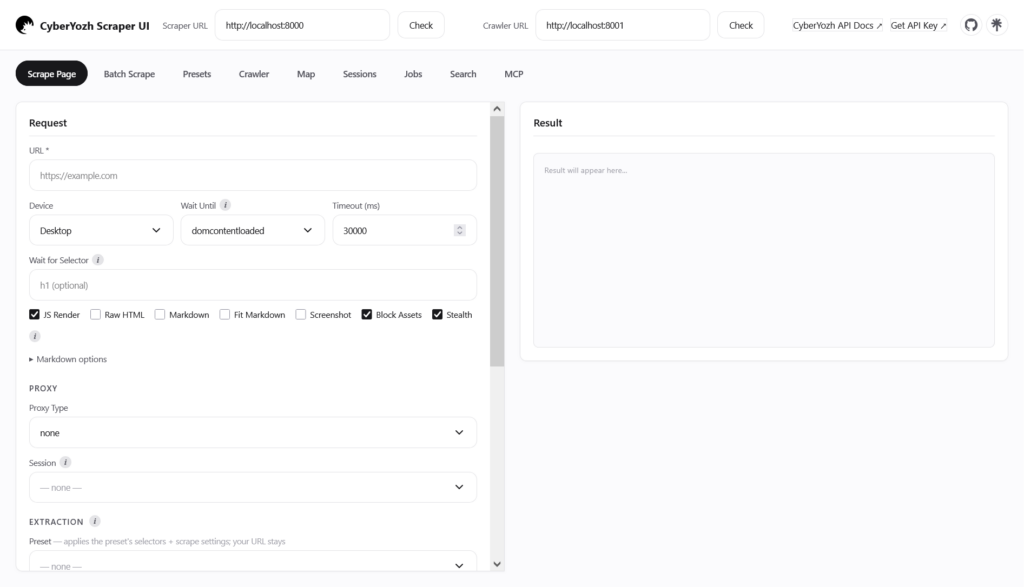
Yozh Scraper uses Taskiq and Redis queues to guarantee high availability. The main API container simply enqueues tasks and reads results. Multiple scraper-worker containers operate the Playwright instances. Because Redis stores all job states, results, and sessions, the API survives instant restarts. You never drop workloads. And you can scale the browser fleet horizontally with a simple Docker Compose command.
Ensuring stable automated access
Modern targets block automated requests using behavioral analysis and TLS fingerprinting. Yozh Scraper handles this at the architectural level.
- Real Chrome & Camoufox: It drops the bundled Chromium for complex targets. Instead, Camoufox generates a fresh, statistically valid browser fingerprint (OS, GPU, threads) on every single launch.
- WebRTC leak protection: The built-in WebRTC script mimics native browser behavior. Your network footprint stays completely protected.
- Server-managed context: You log in once using a declarative JSON script. The server takes over, remembering cookies and locking in the proxy assignment.
- On-the-fly cookie injection: Hit a complex challenge? Push valid session cookies directly into the API via the Yozh Scraper UI. Access restores instantly.
The Engine Core: LLM Self-Healing Parsing in Yozh Scraper
LLM self-healing parsing is the core of Yozh Scraper. It combines hardcoded speed with AI adaptability to keep your data pipelines alive.
The workflow starts with standard CSS or XPath presets. This keeps routine extraction fast and costs exactly zero API tokens. But target sites change. A front-end team deploys an A/B test. The layout shifts. A required schema field comes back empty.
Instead of crashing, the scraper falls back to the LLM. The AI reads the raw HTML. It analyzes your required output schema. It semantically locates the missing data points despite the broken selectors and extracts them on the fly. Your data keeps flowing. You write zero manual code updates. Pipeline downtime drops to zero.
Enabling this takes seconds. Store your API keys securely in the environment file. Then simply append the llm object to your JSON payload:
Generating Pure Datasets for AI Training
Large language models choke on messy, unstructured HTML. Yozh Scraper fixes this with a built-in noise-filtering engine.
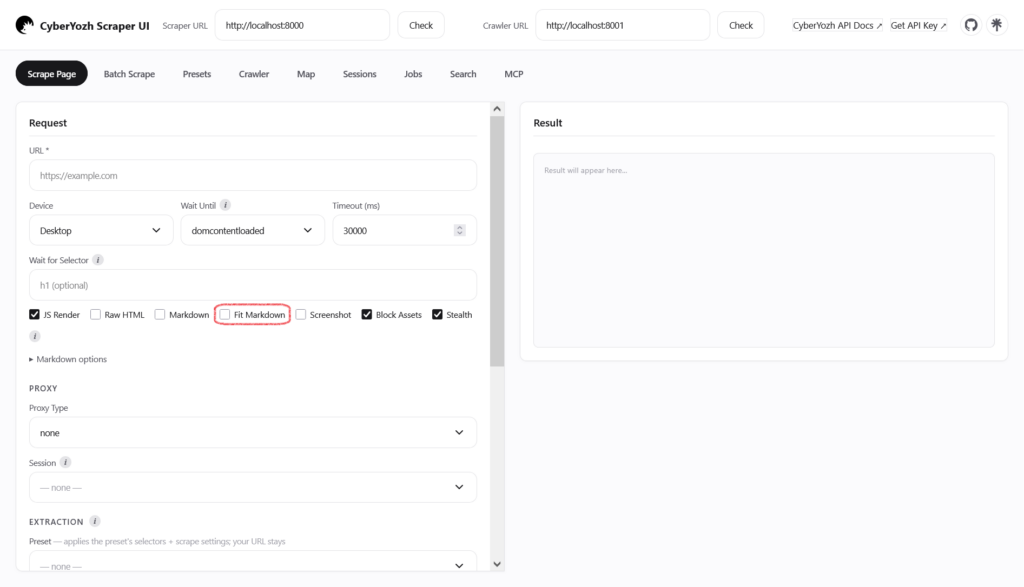
Just request the fit_markdown format in your payload. The parser instantly strips out header menus. It drops programmatic ads. It cuts cookie consent banners. You get pure, structured Markdown ready for RAG pipelines and model training. You can finally ditch your secondary data-cleaning microservices.
Connecting AI Agents via Model Context Protocol (MCP)
Autonomous AI agents need structured endpoints to surf the web. Developers usually waste days writing custom middleware to connect external LLMs with local scraping APIs.
Yozh Scraper kills this friction with native Model Context Protocol (MCP) support. Both the scraper and crawler mount MCP endpoints via Streamable HTTP. This instantly exposes tools like run_scrape_page, cancel_scrape_job, and create_crawl to any compliant AI environment.
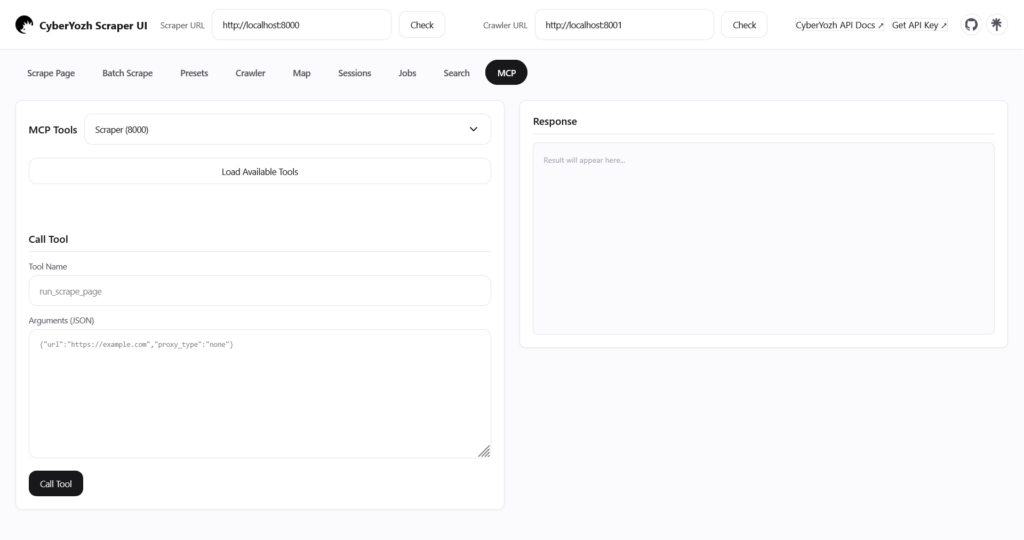
Integration takes seconds. Just drop the server URLs into your Claude Desktop configuration file:
Once connected, the AI navigates the web on its own. You type: “Crawl example.com with a depth of 2 and summarize the pricing pages.” The agent submits the job. It polls the async status. It fetches the Markdown results. You write zero execution logic.
Scaling operations with the CyberYozh App ecosystem
Sending high-frequency requests from cheap datacenter IPs guarantees instant connection drops. To scale reliably, Yozh Scraper integrates directly with the CyberYozh App ecosystem.
CyberYozh App is a robust web automation platform. Strict no-logs policy. Pure pay-as-you-go pricing.
Scalable proxy infrastructure
- Mobile proxies (from $1.7/day): Route traffic through real LTE/5G mobile devices. Maximize your Trust Rate. Manage multiple social profiles and access local content safely.
- ISP residential proxies (from $5.29/month): Get static IPs tied to actual home internet providers. Maintain 99.9% uptime and natural traffic patterns for long-term e-commerce extraction.
- Rotating residential (from $0.9/1GB): Access a pool of 50M+ dynamic IPs across 195+ countries. The optimal choice for mass price aggregation and stable automated registrations.
👉 Explore the CyberYozh proxy catalog and choose the right network for your pipeline.
Verification and fraud evaluation
- Virtual & residential numbers: Rent numbers for one-time SMS reception (from $0.02) or use high-trust local ISP numbers for fintech registrations.
- Virtual bank cards: Issue tokenized cards instantly for international SaaS subscriptions and ad networks.
- Fraud score checker (from $0.15): See how corporate security systems (Stripe, Amazon) view your digital footprint before you deploy. Check IP abuse velocity and AVS mismatches.
How does LLM self-healing parsing handle dynamic website changes?
Hardcoded selectors break during A/B tests or DOM updates. Yozh Scraper runs your deterministic parser first. If a required field is empty, the built-in AI reads the raw HTML, semantically locates the missing data, and extracts it on the fly. Zero pipeline downtime.
How do server-managed sessions maintain stable access to protected profiles?
Standard scrapers drop the browser context on every request, triggering security alarms. Yozh Scraper maintains a persistent browser session on the server. You authenticate once via a JSON script. The server retains the cookies and proxy assignments. If challenged, you can inject pre-authenticated session cookies directly into the API to restore access instantly.
What is the pricing model?
Yozh Scraper and its Crawler service are 100% open-source and free to self-host. You only pay for the proxy network and infrastructure you consume. CyberYozh App runs on a strict pay-as-you-go model with no monthly minimums.
How does MCP integration connect AI agents?
Yozh Scraper mounts a native Model Context Protocol (MCP) endpoint. Add the server URL to your Claude Desktop config. Tools like run_scrape_page appear automatically, allowing the AI to surf and parse targets autonomously.
How does it prepare data for AI training?
The parser includes a dedicated noise-filtering engine. Request the fit_markdown format. The system automatically strips ads, menus, and cookie banners. You get pure Markdown optimized for RAG pipelines.
How does CyberYozh App ensure stable connections during mass scraping?
CyberYozh App routes your traffic through ethically sourced ISP residential pools and real mobile carrier networks via SOCKS5/HTTP protocols. Use the built-in Fraud Score checker to evaluate your IP’s reputation before deployment, ensuring high-trust requests.