






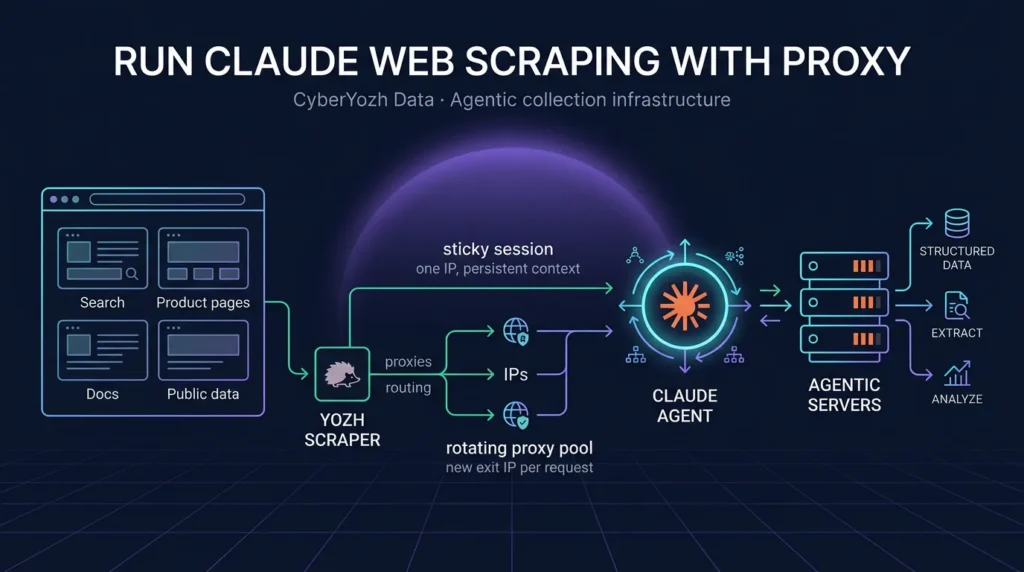
Claude web scraping combines an AI assistant with a normal data-collection stack. However, Claude does not replace a browser, HTTP client, or proxy network. Instead, it helps define what data matters, generate and improve extraction logic, explain errors, and transform collected page content into a consistent format.
Key idea: Claude is the reasoning and extraction layer. Your scraper and proxy infrastructure are the access layer. Here is how it works.
How Claude helps with web scraping
In practical work, this is more useful than asking an AI to “scrape a website.” A reliable workflow separates responsibilities: a scraper fetches permitted pages, a browser renders JavaScript when needed, a proxy provides the network connection, and Claude interprets cleaned page content.
Can Claude scrape websites?
AI web scraping is possible, but the wording needs precision. Claude can help create a scraper, analyze HTML, generate CSS or XPath selectors, classify pages, and return fields such as product name, price, availability, or article date as structured JSON.
However, Claude itself is not a general-purpose crawler with its own configurable browser and proxy endpoint. For live, repeatable collection, connect it to tools such as Python requests, Playwright, or an MCP server.
A practical Claude scraper workflow looks like this:
- Define the permitted source and the fields you need.
- Fetch the page through a configured proxy when appropriate.
- Render the page in Playwright if its content appears only after JavaScript runs.
- Remove scripts, menus, banners, and other DOM noise.
- Send the relevant text or HTML fragment to Claude with a clear output schema.
- Validate the returned data and save it to CSV, JSON, or a database.
Good request: “Extract product title, listed price, currency, stock status, and canonical URL into JSON.”
Weak request: “Read this entire website and find everything useful.”
The first request gives Claude a target and enables validation. The second wastes tokens and creates inconsistent results.
Integrate Yozh Scraper with Claude agents
Yozh Scraper is an open-source CyberYozh stack built around Playwright. It can render pages in a real browser, return extracted fields, raw HTML, or full-page screenshots, and supports asynchronous scraping jobs and crawling from a seed URL. It also exposes MCP endpoints, so Claude-based agents can call scraping and crawling tools instead of trying to work from incomplete page text alone.
Why Claude scrapers require proxies to run fast and smoothly
A Claude scraper can be well written and still fail because the network layer is poor. Repeated requests from one server IP may trigger rate limits, regional differences, or access restrictions. A proxy gives the scraper a controlled route for requests; it does not grant permission to ignore website rules.
Use best residential proxies for Claude AI when pages must be viewed from consumer-network locations or when a workload needs distributed, carefully paced requests. Keep request rates conservative, follow applicable terms and laws, and prefer official APIs, partner feeds, or site-owner permission whenever they are available.
Benefits of Claude web scraping
The main benefit of Claude web scraping is faster iteration. A developer or analyst can describe a data goal in plain language, receive a first extraction approach, test it on real permitted pages, and refine it after page layouts change. Claude is especially useful when many sites describe similar information in different words.
It also helps turn raw pages into usable business data: compare prices, group listings, summarize public documentation, enrich approved lead records, or prepare clean content for internal search and RAG systems. The best results come from a narrow schema, clean input, and validation rules, not from sending entire websites to a model.
The proxy usage: Select a proxy type
Choose a proxy based on the workload only. Each type has a sensible role:
| Proxy type | Best fit for Claude scraping | When to avoid it |
| Mobile LTE/5G | Account-related workflows, geo-sensitive QA, or cases requiring a stable mobile-network identity | Large low-value crawling jobs where cost efficiency matters most |
| Rotating residential | Public-data collection, price monitoring, SEO research, and distributed requests | Workflows that require the same long-lived IP for every step |
| Datacenter | Open-data scraping, uptime checks, testing, and speed-focused collection | Targets that need consumer-network geography or higher trust signals |
CyberYozh identifies:
- rotating proxies for scraping, automation, price monitoring, and aggregation
- datacenter proxies for speed-critical open-data work
- mobile proxies for higher-trust, account-related scenarios.
Use the right rotation strategy
IP rotation strategies should match the website journey. Changing IPs too often can break sessions; keeping one IP for too long can concentrate traffic.
- Sticky session: Keep one IP for a short multi-step flow, such as opening a category page and following its product links.
- Per-request rotation: Use a new IP for independent public pages, such as separate search-result checks.
- Pre-programmed rotation: Change IP after a defined number of pages or a time interval.
- Random rotation: Use only when requests are independent and the provider manages the rotation safely.
Wrong approach: Rotate on every request while carrying cookies from a previous identity.
Better approach: Keep the IP, cookies, headers, and session behavior consistent for one short task; then end that session before starting another.
Who should use web scraping with Claude
Claude web scraping is most valuable for teams that already have a legitimate data task but want less manual parsing work.
| User | Typical usage case | Specific need |
| SEO team | Monitor public SERP and competitor-page changes | Geo-aware checks, scheduled collection, normalized reports |
| E-commerce analyst | Compare public catalog prices and availability | Product matching, structured fields, careful pacing |
| QA team | Test how a public page behaves in different regions | Country or city targeting and repeatable browser sessions |
| Content or RAG team | Convert approved web documentation into clean source material | DOM cleanup, deduplication, metadata, source tracking |
| Sales research team | Enrich business information from permitted public sources | Narrow schemas, compliance review, human verification |
How to build web scraper with Claude Code
To understand how to build web scraper with Claude Code, start small. Do not ask Claude to create a large crawler before you know what one correct record looks like.
- Write a data contract. List the exact fields, accepted formats, and what counts as missing data. Example: title, price, currency, url, and checked_at.
- Choose the fetch method. Use a simple HTTP request for static pages. Use Playwright for pages where content is loaded by JavaScript.
- Add the proxy outside the prompt. Store the proxy URL and credentials in environment variables or protected configuration, not in source code or chat history. Read more about proxy usage in scraping and automation setups.
- Give Claude a sample. Provide one cleaned HTML fragment and one desired JSON record. Ask it to produce selectors or extraction logic.
- Test on a small sample. Compare ten results with the source pages before increasing volume.
- Add safeguards. Use timeouts, retries with limits, logging, deduplication, and human review for uncertain results.
- Scale only after validation. Track success rate, empty fields, response status, and cost per usable record.
Claude Code can work with browser automation tools via MCP. Anthropic’s Playwright plugin, for example, enables browser interaction through page accessibility data and supports tasks such as navigation, screenshots, and form interaction.
Practical rule: First fetch and clean the page. Then ask Claude to extract a small, defined set of fields. This reduces noise, token use, and hallucinated values.
Summary and conclusion
Claude web scraping works best as a practical team: proxies and browsers collect permitted web data, while Claude helps create, refine, and interpret extraction logic. Start with a narrow schema, select the proxy type and rotation method for the task, validate small batches, and scale only when the output is consistently accurate.
Can Claude scrape websites by itself?
Not reliably as a production scraper. Claude can analyze supplied HTML and guide browser tools, but live collection normally requires a fetcher, browser automation, or MCP-connected scraper that retrieves the page content first.
What is a Claude scraper?
A Claude scraper is a workflow where Claude assists with extraction logic, page interpretation, or data normalization while a separate tool fetches and renders pages. Claude is the intelligence layer rather than the network client.
Do I need proxies for Claude web scraping?
Proxies become useful when legitimate workflows need geographic testing, distributed public-page requests, or protection of a work server’s primary IP. Always respect source rules and applicable law.
Which proxy type is best for Claude scraping?
Rotating residential proxies are generally suitable for public-data research and monitoring. Datacenter proxies suit speed-focused open-data tasks, while mobile proxies fit higher-trust or geo-sensitive workflows.
Can Claude Code create a web scraper?
Yes. Claude Code can help generate Python or JavaScript scraper code, revise selectors, diagnose errors, and connect to MCP tools. You still need to test the code, define safeguards, and confirm the data is collected lawfully.
How do I handle JavaScript-heavy websites?
Use a browser automation tool such as Playwright to render the page, then send the cleaned rendered HTML or extracted fields to Claude. This avoids asking the model to infer content that was never present in the original HTML.
Should I send full HTML pages to Claude?
Usually no. Remove scripts, styles, repeated navigation, and unrelated blocks first. Send only the relevant content and a strict output schema. This improves extraction quality and lowers token usage.
Can Claude web scraping be used for RAG?
Yes, when you have the right to collect and process the content. Clean the DOM, preserve source URLs and timestamps, deduplicate records, and keep retrieval data separate from model-generated summaries.