







When evaluating Playwright vs Puppeteer for e-commerce scraping, engineers often obsess over execution speed and API syntax. However, in 2026, the landscape of data extraction has fundamentally shifted. Target websites deploy aggressive behavioral analysis, TLS fingerprinting, and dynamic DOM mutations. Building a pipeline that survives these defenses requires far more than picking a browser automation library.
TL;DR: Playwright vs Puppeteer for e-commerce scraping
- Cut memory consumption. Playwright isolates browser contexts. You use ~40MB of RAM per session. Puppeteer drains ~80MB.
- Watch for CDP leaks. Anti-bot systems analyze the Chrome DevTools Protocol. Calling Runtime.enable exposes your scripts immediately.
- Protect your network footprint. Marketplaces reject datacenter IPs. CyberYozh Data residential and mobile proxies provide stable access to product catalogs.
- Deploy AI parsers. Yozh Scraper UI heals broken CSS selectors automatically. You get pure Markdown datasets for model training.
Browser architecture: Managing memory at scale
To settle the debate of Playwright vs Puppeteer for e-commerce scraping, you must look at resource consumption at scale. Legacy tools like Selenium drain around 150MB of RAM per session. Puppeteer, Google’s Chromium specialist, reduces this footprint to approximately 80MB.
Playwright, however, introduces isolated browser contexts. This architecture allows developers to run multiple independent sessions each with its own cache, cookies, and proxy configuration within a single browser instance, slashing memory consumption to just 40MB per context.
When crawling tens of thousands of product pages, this structural advantage prevents memory leaks and zombie processes from crashing your servers.
The illusion of invisibility and CDP leaks
The biggest pitfall in Playwright vs Puppeteer for e-commerce scraping is the illusion of invisibility. Developers historically relied on plugins like puppeteer-extra-plugin-stealth to mask automation flags. Today, this package is effectively unmaintained and built for outdated Chrome 109-112 detection patterns.
Modern Web Application Firewalls (WAFs) like Cloudflare and DataDome no longer just check the navigator.webdriver flag. They monitor the Chrome DevTools Protocol (CDP). The moment your script calls the Runtime.enable method to interact with the DOM, anti-bot systems detect the CDP leak and flag the session. If your browser declares itself as Chrome 120 but your TLS JA3 fingerprint matches a basic Node.js HTTP client, Cloudflare will instantly serve an Error 1020 access denial.
Why smart IP rotation is the differentiator
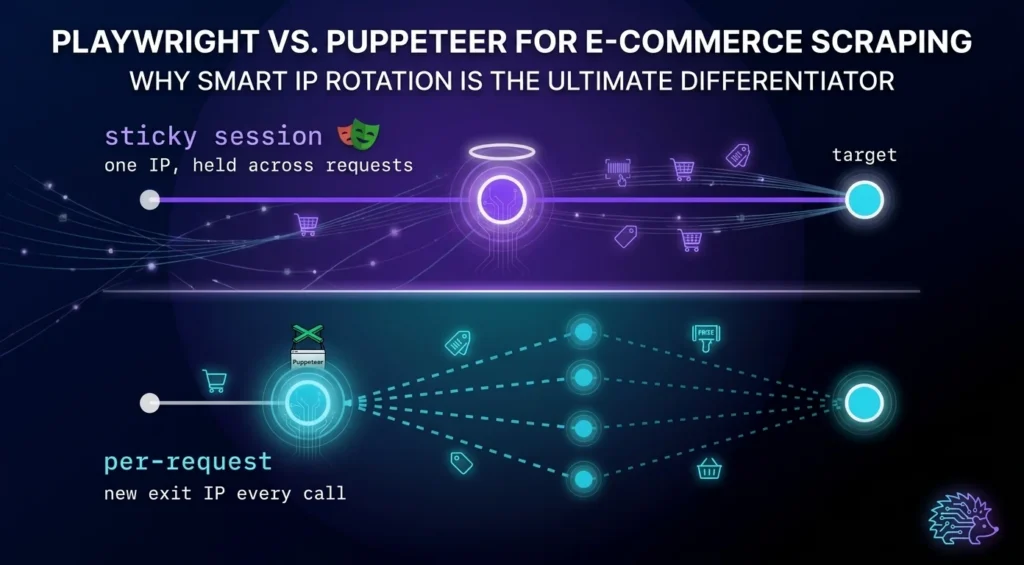
This brings us to the core truth about Playwright vs Puppeteer for e-commerce scraping: without an elite proxy network, both frameworks will fail. E-commerce platforms track IP reputation mercilessly. Standard shared datacenter IPs struggle against advanced firewalls.
Premium dedicated server IPs work perfectly for B2B portals and internal APIs. But to scrape high-trust consumer marketplaces, you must emulate legitimate human traffic.
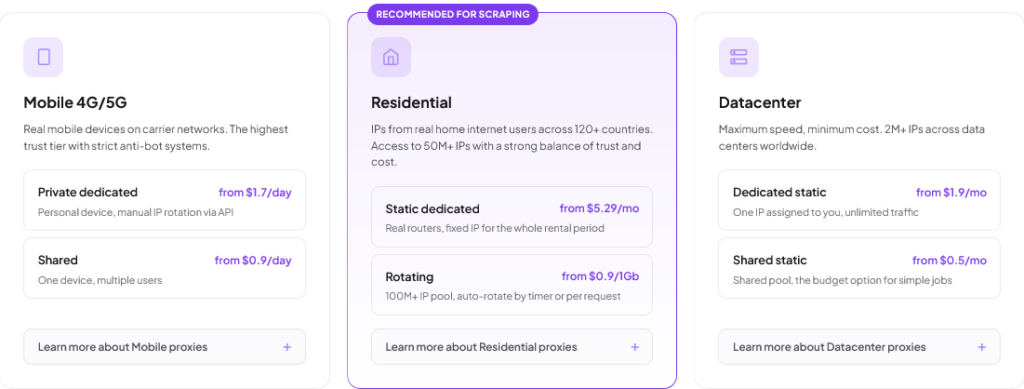
When configuring this routing, protocol mechanics matter. CyberYozh Data proxies support both HTTP and SOCKS5 protocols. The proxy acts strictly as a network pipe. Payload encryption is determined entirely by whether the target endpoint uses HTTPS, not by the proxy type itself. This guarantees data security during extraction. CyberYozh Data provides a comprehensive, no-logs proxy ecosystem designed specifically for high-volume data collection:
- Premium datacenter proxies (from $1.9/month): Deploy corporate-grade dedicated servers. They provide 99.99% uptime and zero IP sharing. Perfect for scraping B2B catalogs, GraphQL endpoints, and analytics platforms without aggressive behavioral analysis.
- Rotating residential proxies (from $0.9/1GB): Tap into a pool of over 50 million IPs across 100+ countries. Essential for mass catalog indexing, these proxies support sticky sessions (up to 24 hours) to maintain a consistent identity during checkout or deep navigation flows.
- ISP residential proxies (from $5.29/month): Get dedicated static IPs from real internet service providers. They offer 99.9% uptime and high speeds, perfect for holding long-term authenticated sessions.
- Mobile proxies (from $1.7/day): Leverage private IPs from real 5G/LTE carrier networks. Because carriers use CGNAT, blocking a mobile IP risks blocking hundreds of real users, giving these proxies the highest possible Trust Rate.
👉 Start routing your traffic through 50M+ rotating residential IPs with CyberYozh now.
Enter CyberYozh Scraper UI: Autonomous data extraction
If you are comparing Playwright vs Puppeteer for e-commerce scraping, you should also evaluate the orchestration layer. Hardcoded CSS selectors break constantly during A/B testing on target sites.
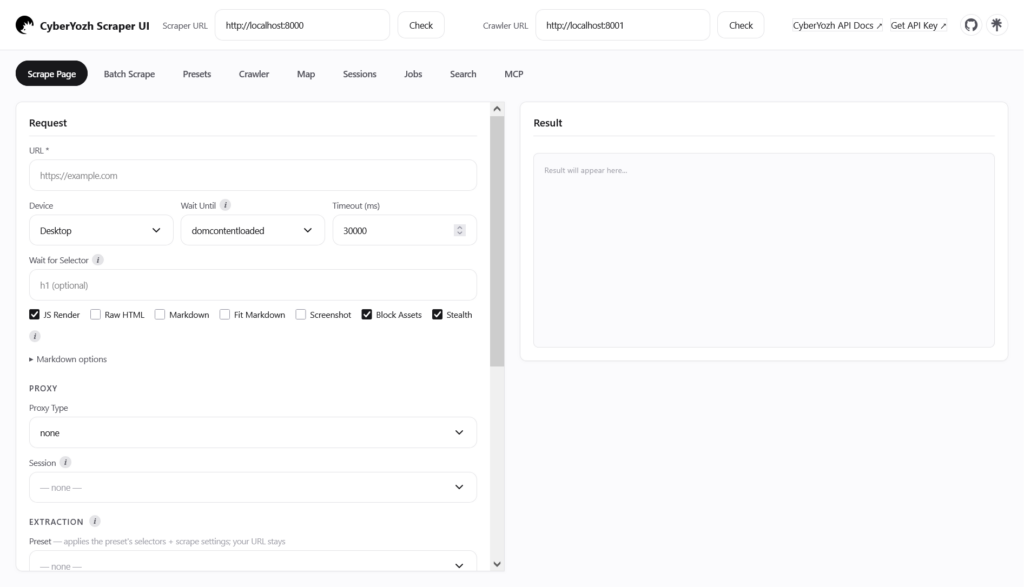
To end this cycle of broken pipelines, the open-source Yozh Scraper (formerly CyberYozh Open Scraper) introduces a visual Node.js frontend CyberYozh Scraper UI running on port 7000. It handles the heavy lifting of browser rendering while offering features built for the AI era:
- LLM self-healing parsers: When a layout changes, the engine doesn’t crash. The LLM fallback reads the raw HTML, locates the missing data, and extracts it on the fly.
- Pure Markdown Datasets: By requesting the fit_markdown format, the engine strips out ads, navigation menus, and cookie banners, delivering noise-filtered text optimized for training AI models.
- Server-Managed Authenticated Sessions: Log in once using a declarative JSON script. The server maintains the persistent browser context and proxy assignment, allowing you to scrape behind login walls without triggering re-authentication blocks.
- Native MCP Integration: Both the scraper and crawler expose Model Context Protocol (MCP) endpoints via Streamable HTTP. You can connect tools directly to Claude Desktop or LangChain, allowing autonomous AI agents to crawl and summarize sites without custom middleware.
👉 Download the open-source Yozh Scraper on GitHub and test the visual UI locally.
The winner in Playwright vs Puppeteer for e-commerce scraping is the team that builds the most resilient pipeline. By combining the isolated contexts of Playwright, the autonomous AI routing of Yozh Scraper, and the top-tier residential proxy network from CyberYozh Data, you can transform fragile scripts into an enterprise-grade data engine.
Is Playwright faster than Puppeteer for web scraping?
Execution speed is nearly identical. Both frameworks communicate via the Chrome DevTools Protocol. Playwright wins dramatically in parallel processing. It launches multiple isolated contexts within one browser instance. This saves memory and prevents server crashes during large-scale catalog extraction.
What is the best alternative to puppeteer-extra-plugin-stealth?
Stop relying on third-party plugins. Modern anti-bot systems detect them easily. The current standard requires changing your actual network footprint. Use Playwright with high-trust mobile or residential proxies from CyberYozh Data. This routes your traffic through legitimate carrier networks instead of trying to alter browser code.
How to fix Cloudflare Error 1020 in headless browsers?
Error 1020 means the server rejected your IP reputation or TLS fingerprint. If you are using free shared datacenter IPs, drop them immediately. Switch to premium dedicated servers or rotating residential IPs. Ensure your browser’s TLS JA3 signature exactly matches the declared User-Agent.
Residential vs Mobile proxies for e-commerce scraping: Which is better?
Residential proxies work best for mass price monitoring. They offer millions of IP addresses for heavy rotation across global regions. Mobile proxies provide the highest possible Trust Rate due to CGNAT technology. Deploy mobile proxies for targets using the most aggressive behavioral analysis.
How to reduce Playwright memory consumption in Node.js?
Never launch a new browser instance for every URL. Launch a single Chromium process. Create independent sessions using the browser.newContext() method. This drops RAM usage to about 40MB per thread and keeps your servers stable.
How to extract data with LLMs when CSS selectors break?
Deploy self-healing parsers. Yozh Scraper includes an AI fallback mechanism natively. When a traditional XPath fails, the engine feeds the raw HTML to an LLM. The model identifies the required fields and extracts the data on the fly.