





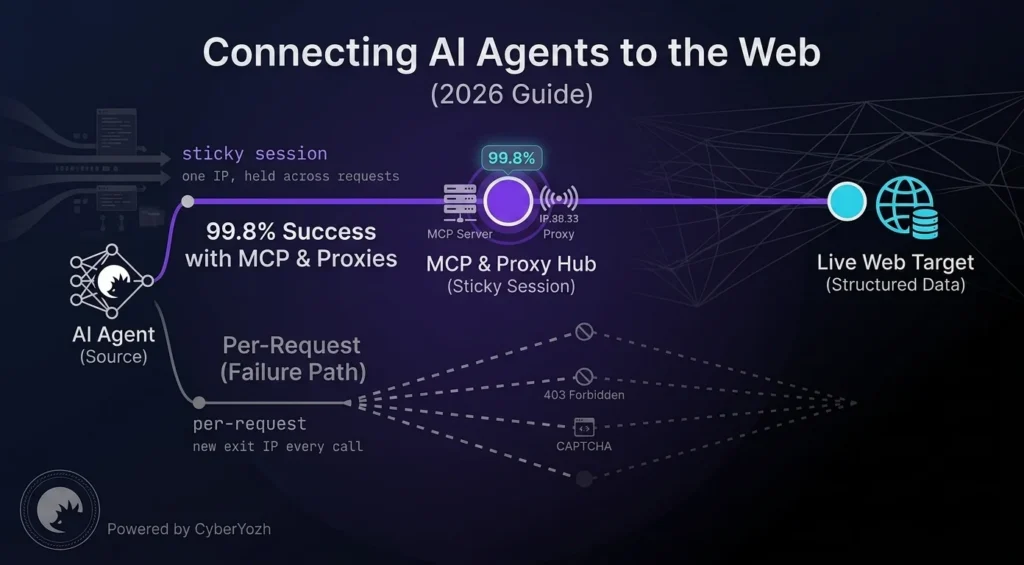
Quick Answer: The Model Context Protocol (MCP) acts as a universal bridge, allowing AI agents (like Claude Desktop or Cursor) to navigate the live web, render JavaScript, and extract structured data. However, to prevent IP bans and CAPTCHAs during automated web crawling, AI agents must route their requests through high-trust residential or mobile proxies that support extended sticky sessions.
What is the Model Context Protocol (MCP) and how does it empower AI agents
Autonomous AI agents are shifting from passive chat interfaces to active internet operators. Instead of relying on static, outdated training data, these agents require real-time web access. The Model Context Protocol (MCP), developed by Anthropic, serves as a “USB interface” for Large Language Models (LLMs). It allows an AI agent to discover and invoke external tools directly.
When you ask an agent to perform automated web crawling for LLMs, the MCP server receives the prompt, navigates to the target, renders the page, and returns token-efficient Markdown or JSON. This eliminates the need to process heavy, noisy HTML, saving massive amounts of context window tokens.
Why do autonomous AI crawlers fail with standard IPs
Modern web defense is aggressive. Platforms like Cloudflare and DataDome evaluate every single request in milliseconds. An agent tries to access an e-commerce platform using a generic datacenter IP. The result is always the same. The site throws up a CAPTCHA or drops the connection entirely.
If your AI agent uses a generic datacenter IP to execute a multi-step task such as logging into an e-commerce platform and aggregating regional prices it will almost certainly trigger a challenge page or a silent ban. Furthermore, if the IP rotates mid-task, the website invalidates the session entirely. AI agents need persistent network identities, making high-trust IP for automated browsing a strict requirement.
How to overcome bot detection when connecting AI to web data?
To ensure your RAG (Retrieval-Augmented Generation) pipelines and AI agents run flawlessly, you must upgrade your transport layer. The CyberYozh mobile proxy infrastructure is specifically designed to handle agentic traffic.
By utilizing a pool of over 50 million IPs across 195+ countries, developers can ensure that every request appears as a legitimate human user.
- For Price Aggregation: Use residential rotating proxies (from $0.9/GB) that offer up to 24-hour sticky sessions. This allows the AI agent to complete complex, multi-page interactions without losing its session state.
- For Marketing Automation: Managing multiple profiles across social platforms requires the highest Trust Rate. Utilizing real 4G/5G carrier IPs (starting at $1.7/day) coupled with the open-source Yozh Scraper allows the agent to emulate real smartphone hardware.
3 real-world scenarios: From scraping to automated checkout
Data extraction is just step one. We combine MCP servers with real 4G/5G carrier IPs to build fully autonomous pipelines.
Scenario 1: Protecting RAG pipelines from hallucinations
Your agent gets a prompt to scrape regional marketplace prices. We configure the MCP server to route traffic through residential proxies. A massive IP pool guarantees local network presence. Extended sticky sessions let the agent navigate from search results to user reviews seamlessly. Zero corrupted data.
Scenario 2: Isolating social media profiles
Marketing AI agents publish content automatically. Social platforms immediately flag suspicious IP ranges. The fix is simple. Deploy mobile proxies. The agent gets the exact Trust Rate of a physical AT&T or Verizon device. To register the profile initially, the agent uses the platform’s SMS verification service. It rents a residential number and receives the text for just $0.02.
Scenario 3: Automated ticket booking
An agent monitors hotel listings and books tickets when prices drop. Payment gateways reject bot-like transactions. Before initiating payment, the agent pings the built-in CyberYozh Fraud Score checker. For $0.15, it confirms the risk is low. Then it generates a virtual tokenized bank card directly via the platform. The transaction clears instantly.
Bright Data vs. Firecrawl vs. CyberYozh: Which is best for MCP server integration
Choosing the right ecosystem dictates both your monthly burn rate and extraction quality.
| Feature | Bright Data MCP | Firecrawl MCP | CyberYozh App & Yozh Scraper |
| Pricing Model | High SaaS rates ($8/GB for browsing) | Fixed tiers (Standard $83/mo) | Pay-as-you-go traffic (from $0.9/GB) |
| Local Agent Control | Requires managed zones | API-based (REST interaction) | Full local Playwright control |
| Token Efficiency | Often returns raw bulk data | High initial token load (7,582 tokens) | Optimized Markdown/JSON via Camoufox |
Cloud solutions like Firecrawl work fine for a quick start. But they completely strip away your flexibility. If your agent needs to physically click through complex elements or target specific geolocations, configure your own scraper. Connecting it with CyberYozh delivers higher success rates and saves your budget as you scale.
👉 Grab Yozh Scraper on GitHub.
Do all AI agents need proxies?
No. A simple one-off API query usually functions fine. However, if your agent is scraping dynamic JavaScript rendered pages via MCP server, executing multi-step logins, or aggregating competitor data, proxies are mandatory to prevent rate limiting.
What is the difference between an MCP server and a proxy?
An MCP server connects an AI agent to external scraping tools, translating web data into AI-readable text. A proxy controls the network identity, IP address, and geographic location behind that connection.
Why do AI agents need sticky sessions?
If an AI agent adds an item to a cart or logs into a portal, a sudden IP change will cause the website to terminate the session for security reasons. Sticky sessions hold one IP for the task’s duration.
How do I prevent my agent from hallucinating data?
Hallucinations often happen when a crawler hits an anti-bot CAPTCHA page, and the LLM tries to read the CAPTCHA text as actual content. Routing the AI agent residential or mobile proxies with high success rates prevents challenge pages from appearing in the first place.
Can I run MCP servers locally on my own hardware?
Yes. Running a local MCP server gives you total control over the data pipeline. You avoid cloud provider restrictions. Connect your local instance (like Cursor or Claude Desktop) directly to Yozh Scraper. Then route the traffic through residential or mobile proxies. This keeps your API keys secure and cuts unnecessary SaaS fees.