







Targeting modern websites to train AI models breaks traditional data extraction pipelines. You point a headless browser at a dynamic product catalog. The target server instantly analyzes your TLS Client Hello signature. It checks your HTTP/2 frame sequence before sending a single byte of data. If your connection lacks a robust proxy ecosystem for web automation, the enterprise firewall drops your request before rendering a single pixel.
But passing the initial security check is only the first step.
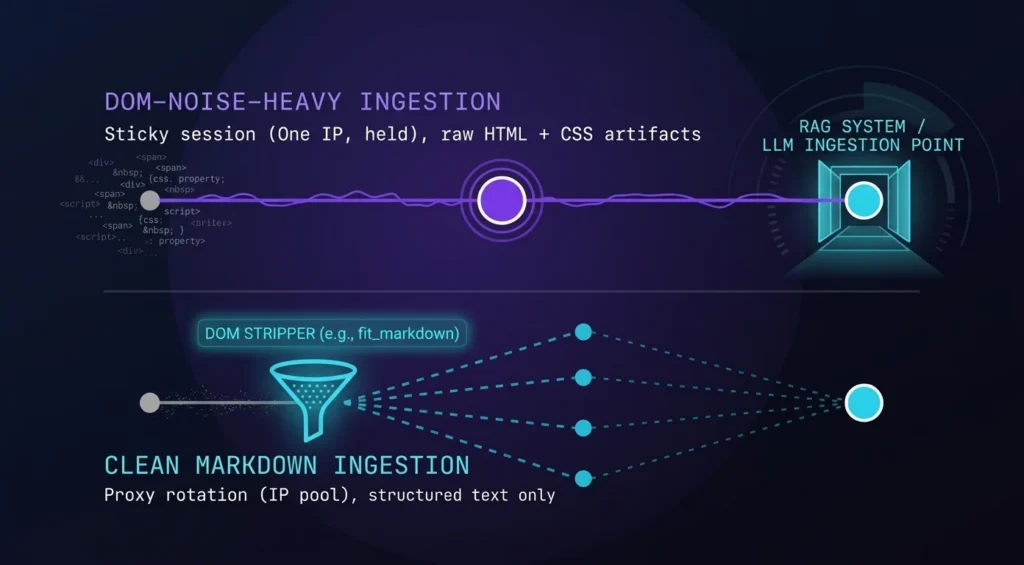
Raw HTML ruins Retrieval-Augmented Generation (RAG) applications. The valuable text is buried under megabytes of JavaScript files, cookie consent banners, and complex navigation menus. You must strip DOM noise before sending anything to your vector database. Clean LLM ingestion requires structural discipline and the right network hardware.
TL;DR: Scaling AI data extraction
- Stop feeding LLMs raw code. Use tools that strip DOM noise natively.
- Build a proxy ecosystem for web automation to maintain continuous agent sessions.
- Align your network protocols. AI scrapers need clean LLM ingestion pipelines without dropped packets.
- Isolate browser contexts. Keep memory footprints under 40 MB per thread.
Why raw HTML breaks RAG models (and how to strip DOM noise)
Real user case: A retail analytics team tried processing raw Nike product pages. Their Claude 3.5 Sonnet agents hallucinated constantly. The model read hidden CSS classes and promotional banners instead of actual product specifications.
You fix this by formatting data at the extraction point. Tools like Yozh Scraper utilize a specific fit_markdown function. This engine analyzes the raw HTML instantly. It removes advertising blocks and structural menus automatically. The output is structured text built strictly for clean LLM ingestion. You save thousands of dollars on API token costs because you stop sending junk data to the generative model.
👉 Download the open-source code now
How to maintain stable MCP agent sessions without dropped packets
Autonomous agents require uninterrupted communication channels. The Model Context Protocol (MCP) standardizes how these AI models interact with external browser environments. An intelligent agent might take five minutes to navigate a dynamic single-page application and verify inventory numbers.
If your IP changes abruptly during this reasoning process, the target server resets the connection. The agent loses context entirely.
You need a dedicated proxy ecosystem for web automation to handle persistent routing. A premium rotating residential pool provides over 100 million IP addresses across 195 countries. You configure sticky sessions to hold the exact same IP for up to 24 hours. This gives your MCP agents the stability they need to finish complex transactional processes without triggering rate limits.
👉 Connect residential rotating proxies
How to overcome enterprise firewalls and protect your network footprint
Enterprise firewalls deploy aggressive countermeasures against data collection. Cloudflare AI Labyrinth generates endless fake data loops to trap automated crawlers. Security systems analyze cryptographic signatures to catch basic Python scripts. The introduction of Post-Quantum TLS (Kyber768) in modern Chrome versions increased the size of the Client Hello packet significantly. If your script fails to replicate this exact cryptographic weight, the target server knows you are running a bot.
Handling these systems demands a multi-layered approach. You pair your server-side extraction tool with a proxy ecosystem for web automation.
Here is how different nodes handle specific AI workloads:
| IP Infrastructure | Starting Price | Best AI Extraction Use Case |
| Mobile (5G/LTE) | $1.7 / day | Navigating strict behavioral filters. Carrier-grade CGNAT prevents blanket IP bans. |
| Static ISP | $5.29 / month | Long-running agent sessions requiring high-speed data transfer and static locations. |
| Rotating Residential | $2 / GB | Mass SERP aggregation and parallel agent workflows targeting consumer platforms. |
| Datacenter | $1.77 / month | Querying unprotected internal B2B APIs at maximum network throughput. |
Deploying this proxy ecosystem for web automation ensures your network footprint matches your software sophistication.
Playwright vs. Puppeteer: Which framework optimizes memory at scale
Scaling data extraction requires absolute hardware efficiency. Playwright isolates browser contexts natively. You consume roughly 40 MB of memory per session. Puppeteer eats closer to 80 MB.
You must configure your scripts properly to achieve these exact hardware metrics:
- Launch a single Chromium process. Stop firing up a new browser instance for every target URL.
- Generate sessions via browser.newContext(). This spawns lightweight, isolated environments with independent proxy and cookie profiles.
- Intercept heavy media requests. Drop image and font payloads at the network level before they consume your RAM.
- Terminate contexts immediately. Run context.close() the exact moment you extract the data to kill zombie processes. This setup prevents massive server crashes. You keep your pipeline lean. High-speed datacenter IPs work perfectly for internal APIs. But scraping strict consumer catalogs demands a different network footprint. You must route your optimized code through legitimate consumer networks.
👉 Scale your autonomous data pipeline
Architecting the ultimate pipeline
Stop patching outdated scripts. Integrating your code into a unified proxy ecosystem for web automation changes everything. You run a single API request. Your server-side AI scraper handles the dynamic JavaScript and corrects broken selectors automatically. The platform routes traffic through legitimate local internet service providers.
Your engineering team stops fighting CAPTCHAs. They focus purely on data analysis. Because when you build a resilient proxy ecosystem for web automation, your LLM agents finally operate at their full potential.
👉 Route your LLM traffic today
Why does my Playwright scraper timeout constantly?
Strict target servers often drop connections silently when they detect non-residential traffic. High-speed datacenter IPs work perfectly for open endpoints. But secure catalogs demand residential routing. A complete proxy ecosystem for web automation dynamically directs your traffic through trusted residential nodes for these tasks. The pages load instantly.
How to fix Cloudflare Error 1020 when scraping?
Error 1020 flags a mismatched cryptographic signature. Your TLS handshake does not match your declared user agent. You must align your network layer. Use residential IPs and implement tools that match TLS fingerprints accurately.
How to achieve clean LLM ingestion from heavy JavaScript sites?
Raw DOM structures confuse generative models. You must process the HTML before ingestion. Execute JavaScript on a remote server. Use tools like Yozh Scraper to extract only the core text content. Clean LLM ingestion requires stripping navigation menus entirely.
CDP leaks expose my headless browser. What is the fix?
Security systems detect the Runtime.enable command instantly. Basic stealth plugins no longer solve this. You need deep browser isolation. Combine patched Chromium builds with a proxy ecosystem for web automation to prevent network-level identification.
When should I use datacenter IPs instead of residential ones?
Datacenter IPs deliver massive bandwidth and near-zero latency. They work perfectly for unprotected B2B APIs and fast data aggregation. Strict consumer platforms simply require a different approach. You switch to residential proxies for those specific modern e-commerce targets to maintain a high trust score.
How to maintain logged-in sessions without getting blocked?
Stop rotating your IPs on every request. Assign a static ISP proxy to each specific account profile. Keep the session sticky. The target platform sees normal human behavior and stops throwing CAPTCHAs.
Mobile LTE/5G proxies vs. Rotating Residential pools: Which is better?
Rotating pools provide millions of addresses. They handle massive catalog scraping perfectly. Mobile proxies utilize CGNAT. They provide the ultimate trust score for highly restricted platforms. A proper proxy ecosystem for web automation deploys both simultaneously.