







TL;DR: Overcoming browser bottlenecks
- Replace RAM-heavy headless browsers with lightweight HTTP scripts.
- Anticipate and manage physical network drops during modem resets.
- Master handling mobile IP rotation via REST API requests.
- Build asynchronous resilience using modern tools like httpx and asyncio.
Browser automation carries massive computational overhead. Headless browsers consume gigabytes of RAM. They render unnecessary DOM elements. They spike CPU usage during simple data extraction tasks. Data engineers eventually hit hard scaling limits when running hundreds of Selenium or Playwright instances. Moving your logic directly to HTTP-level scripts solves this hardware bottleneck completely.
But replacing browsers with raw scripts introduces a severe architectural challenge. You lose the browser’s native ability to handle connection drops gracefully. This missing layer becomes obvious when you integrate cellular networks. It requires precise code. It demands a deep understanding of transport layer physics. We will transition your architecture from heavy browser instances to high-performance scripts using modern libraries.
Surviving the 2-5 second mobile modem rotation window
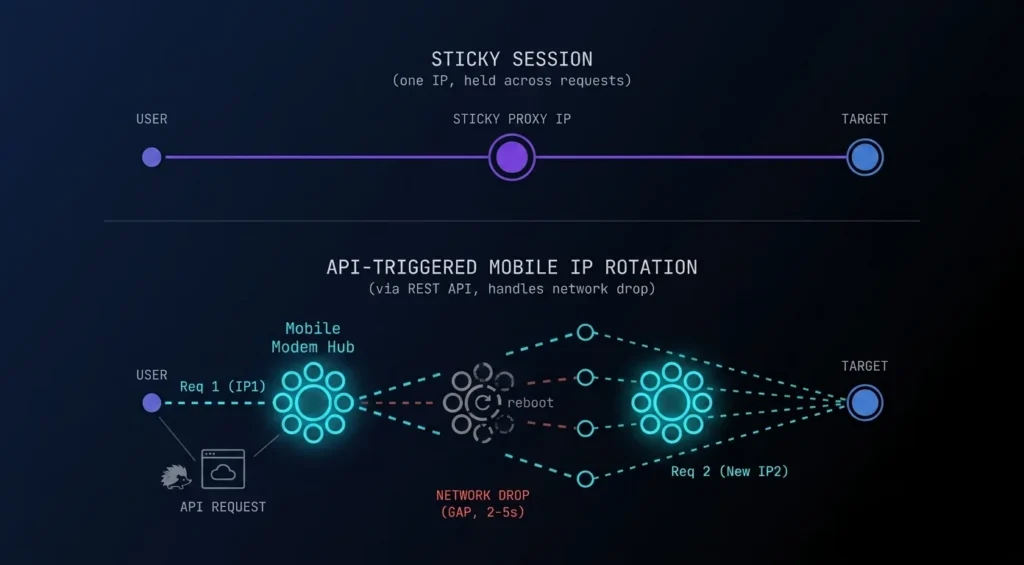
Cellular proxies operate on real hardware. They connect to physical cell towers operated by carriers like AT&T or T-Mobile. You trigger an IP change through a dashboard or an endpoint. The hardware modem physically disconnects from the cellular network. It requests a new address from the carrier’s CGNAT pool. It then re-establishes the radio connection.
This hardware process takes time. You face a strict hardware disconnect phase lasting several seconds. During this gap, the proxy node goes completely offline. Any active HTTP request fails instantly. The transport layer returns fatal errors. Standard scripts crash immediately with connection timeouts or socket closure exceptions.
To survive this hardware reality, your code needs aggressive resilience. Properly handling mobile IP rotation via REST API requests means predicting these exact network failures. You cannot simply use hardcoded time.sleep() commands. Static delays waste valuable pipeline processing time. They also fail catastrophically if the carrier network experiences localized latency and takes ten seconds to assign a new address instead of three.
Catching network drops in automated web scraping with Python
Understanding the exact failure mode helps you write better error catchers. When the modem drops off the network, the TCP handshake fails. Your script attempts to send a SYN packet to the proxy port. The port is temporarily closed or unresponsive. The operating system network stack waits for an ACK packet that never arrives.
This results in a ConnectTimeout or a ConnectionRefusedError. If the rotation happens exactly while you are downloading a large JSON payload, the socket breaks mid-stream. This throws a ReadTimeout or a ProtocolError. Your parsing logic must catch all these specific transport exceptions.
Wrapping your entire function in a generic Try/Except Exception block is bad engineering. It masks critical logic bugs. You must specifically target network-level exceptions to ensure your scraper only pauses for rotation events and crashes properly on bad code.
Exponential backoff data flow management
Dumb retry loops hammer the proxy port continuously. Sending fifty requests per second to an offline modem causes local socket exhaustion on your server. A mathematical delay algorithm fixes this. The algorithm intercepts the specific timeout exception. It waits a short duration. It retries. If the connection fails again, it doubles the wait time.
Dynamic alignment with carrier networks
This mathematical progression accounts for the unpredictable 2-5 second mobile modem rotation window. Sometimes the carrier assigns a new IP in one second. Sometimes it takes four seconds. Exponential backoff data flow management aligns your script with the physical modem state dynamically. It protects your local sockets from retry spam. It guarantees your script resumes parsing the exact millisecond the new address becomes available.
Adding jitter for high concurrency
We also add a random factor called “jitter” to the math. Jitter prevents hundreds of concurrent threads from waking up and hitting the proxy at the exact same microsecond. It smooths out the CPU load on your scraping server. Handling mobile IP rotation via REST API requests becomes highly efficient for the larger data pipeline.
👉 Deploy private mobile proxies
Python script handling network timeouts during rotation
We will build a robust, object-oriented script. We use httpx because it provides modern HTTP/2 support and handles connection pools far better than legacy libraries.
The rotation logic relies on the official CyberYozh API. You must send a POST request to the /refresh-ip/ endpoint, passing your X-Api-Key in the headers and the proxy UUID in the JSON body.
A high-quality script never assumes the IP changed just because the modem reconnected. Carrier networks sometimes assign the exact same IP address from their CGNAT pool if the local tower is congested. You must confirm the address change.
import httpx
import time
import random
import logging

logging.basicConfig(level=logging.INFO)

class MobileProxyManager:
    def __init__(self, proxy_url, api_key, proxy_id):
        self.proxy_url = proxy_url
        self.api_key = api_key
        self.proxy_id = proxy_id
        self.api_endpoint = "https://app.cyberyozh.com/api/v1/proxies/user-proxy-server/refresh-ip/"
        self.proxies = {"http://": proxy_url, "https://": proxy_url}
        self.current_ip = None

    def get_external_ip(self):
        try:
            with httpx.Client(proxies=self.proxies, timeout=10.0) as client:
                response = client.get("https://api.ipify.org?format=json")
                response.raise_for_status()
                return response.json().get("ip")
        except httpx.RequestError as e:
            logging.error(f"IP check failed: {e}")
            return None

    def refresh_ip(self):
        logging.info("Requesting hardware modem rotation...")
        self.current_ip = self.get_external_ip()

        headers = {
            "accept": "application/json",
            "X-Api-Key": self.api_key,
            "Content-Type": "application/json"
        }
        payload = {"id": self.proxy_id}

        try:
            # Hitting the CyberYozh API directly
            response = httpx.post(self.api_endpoint, headers=headers, json=payload, timeout=5.0)

            if response.status_code == 429:
                logging.warning("Rate limit hit. Maximum 1 request per minute allowed.")
                return False

            response.raise_for_status()
        except httpx.RequestError as e:
            logging.error(f"API request failed: {e}")
            return False

        return self._wait_for_new_ip()

    def _wait_for_new_ip(self):
        max_retries = 6
        base_wait = 1.0

        for attempt in range(max_retries):
            # Applying exponential backoff with jitter
            wait_time = (base_wait * (2 ** attempt)) + random.uniform(0.1, 0.5)
            logging.info(f"Waiting {wait_time:.2f} seconds for modem recovery...")
            time.sleep(wait_time)

            new_ip = self.get_external_ip()

            if new_ip and new_ip != self.current_ip:
                logging.info(f"Rotation successful. New IP: {new_ip}")
                return True

        logging.error("Failed to rotate IP after maximum retries.")
        return False
This code establishes total control over the environment. Handling mobile IP rotation via REST API requests becomes a predictable loop. You pass the UUID. The script catches any 429 Rate Limit errors. It calculates the backoff. The scraper resumes with a fresh network footprint.
Scaling REST API requests with Asyncio pipelines
Synchronous scripts block the main thread while waiting for the modem. This ruins performance if you run a large pipeline. Handling mobile IP rotation via REST API requests across hundreds of concurrent tasks requires asynchronous logic.
Using aiohttp or httpx.AsyncClient allows you to park idle requests. The Python event loop pauses the specific task waiting for the modem to reconnect. Other tasks, utilizing different proxy ports, continue processing their data. This architecture maximizes your server resources. Modern data extraction achieves maximum throughput only when network I/O operations are fully non-blocking.
You group your asynchronous tasks by proxy port. When you issue the rotation command, you pause the entire worker group associated with that specific modem. You execute the validation logic once. Once the new IP is verified, you unpause the worker group. They resume extracting data instantly.
👉 Automate your mobile proxies via API
Integration into corporate data pipelines
CyberYozh infrastructure provides dedicated cellular nodes designed specifically for high-frequency automation. These nodes maintain stability even during aggressive rotation phases. You control the exact lifecycle of your network footprint. You dictate the exact moment the address changes to align with your parsing strategy.
Handling mobile IP rotation via REST API requests gives your engineering team precise control over the data gathering environment. Stop relying on slow, memory-heavy browsers. By deploying lightweight, asynchronous Python scripts, your team effectively overcomes network limits. This architecture utilizes the natural trust score of mobile carriers, allowing continuous data extraction without triggering corporate security filters.
What causes connection timeouts during a cellular rotation?
The physical modem disconnects from the carrier radio network to acquire a new lease. It drops the active TCP session. This creates a temporary dead zone where no packets route to your script.
How often should I trigger the rotation endpoint?
Rotate only when mathematically necessary. The CyberYozh API enforces a strict rate limit. You can request a new IP (/refresh-ip/) a maximum of 1 time per minute. Full modem reboots (/reboot/) are limited to 1 time per 5 minutes. Trigger the API only when the target website blocks your payload.
Does httpx perform better than requests for this architecture?
Yes. The library supports HTTP/2 natively. It manages connection pools much more aggressively than older alternatives. The native asynchronous API also provides the exact features needed for scaling your pipelines.
How do I scale handling mobile IP rotation via REST API requests?
Use asynchronous task queues. Group your target URLs by proxy port. Pause the specific queue during the API reset command. Unpause it only after validating the new external address.
Why validate the IP after calling the reset endpoint?
Carrier CGNAT networks are unpredictable. Congested cell towers sometimes assign the exact same IP address back to the modem. Validation ensures your digital footprint actually changed before you resume work.
Can I rotate a shared cellular port via API?
No. API rotation changes the external IP for the physical hardware. This drops connections for all clients sharing that node. Rotation endpoints are exclusively available on dedicated mobile ports.